




India’s Jobs Boost, Anthropic’s Trillion-Dollar IPO, and Nvidia After Jensen Huang
Inside This Week’s Economic Brief This week’s Economic Brief covers India’s improving labour market in October 2026 led by rural areas and women, Anthropic’s $1.5 trillion IPO as a test of investor...

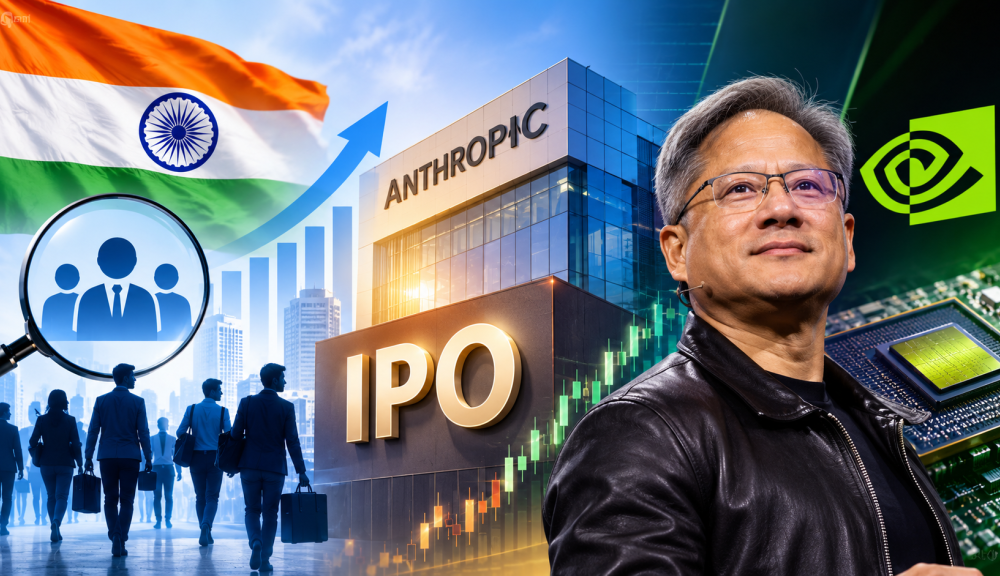
Table Of Content
Inside This Week’s Economic Brief
This week’s Economic Brief covers India’s improving labour market in October 2026 led by rural areas and women, Anthropic’s $1.5 trillion IPO as a test of investor faith in AI, and Nvidia’s record earnings amid leadership uncertainty after Jensen Huang’s exit.
This week’s edition of The Economic Brief on DD India examined three major stories: a further improvement in India’s labour market in October 2026, with more people and more women joining the workforce; Anthropic’s blockbuster IPO at a valuation of about $1.5 trillion; and Nvidia’s record quarterly results, overshadowed by questions over the company’s future without Jensen Huang. The episode featured senior economic journalist Anil Padmanabhan, who has close to four decades of experience covering business and the economy.
India’s Labour Market Strengthens in October 2026
Labour market conditions improved further in October 2026, pointing to a gradual strengthening of employment opportunities across India. Key indicators for people aged 15 and above showed:
- Rising participation. The labour force participation rate rose to 55.7%, as more people took up jobs or actively looked for work.
- Stronger employment. The worker population ratio increased to 53%, indicating that job growth was strong enough to absorb a large number of new job seekers.
- Lower unemployment. The unemployment rate fell to 4.9%, suggesting that a larger share of job seekers are finding work.
Seasonal economic activity, government infrastructure spending, construction and services growth all contributed to the uptick.
Rural areas led the improvement. The rural labour force participation rate rose to 58.4%, the rural worker population ratio climbed to 56%, and rural unemployment remained low at 4.2%. Seasonal farm activity, rural construction and growth in non-farm rural jobs drove the gains, making rural India a key source of employment growth.
Women recorded the most encouraging gains. The female labour force participation rate increased to 35%, the female worker population ratio rose to 33.3%, and female unemployment fell to 5%, with gains particularly strong in rural areas. Higher female participation expands the available workforce, boosts household incomes, raises productivity and supports the long-term growth needed for Viksit Bharat 2047.
Anil Padmanabhan called the rise in women’s participation a very significant and healthy trend, noting that India cannot become Viksit Bharat by 2047 if half its population is outside the workforce. However, he cautioned against declaring victory, saying the key question is the quality and productivity of the jobs being created for both women and men, particularly given skill constraints and the potential for AI to displace workers before they can be reskilled.
He attributed the rise in rural women’s employment to government programmes of the past 10 to 15 years that have freed up women’s time and empowered them financially: access to drinking water, near-saturation coverage of cooking gas, electricity access, and financial inclusion, noting that 50 crore people, more than half of them women, were once unbanked. Looking ahead, he argued that with around 12 million people joining the workforce every year, jobs on that scale can only come from the private sector, which has now taken over from the government as the main driver of growth. To unlock that potential, he called for dismantling the remaining regulatory overhang of the Licence Raj era, particularly at the state level.
Anthropic’s $1.5 Trillion IPO Tests Investor Faith in AI
Anthropic, the company behind the Claude AI models, has launched one of history’s most closely watched IPOs. Priced at $83 per share, it debuts at a valuation of about $1.5 trillion, making it one of the world’s most valuable technology companies. Investors view the offering as a key test of confidence in the AI industry.
One analyst said the IPO is effectively priced on the company’s 2030–31 numbers and described it as a long-term bet on the future, adding that Anthropic’s path to adjusted operating margins of over 10% shows it can control expenses. Strong results from Nvidia have reinforced the view that companies and governments continue to spend heavily on AI infrastructure. At the same time, investors are weighing several risks:
- Intensifying competition from OpenAI, Google, Chinese models and open-source developers, which raises questions about whether Anthropic can sustain premium pricing and its lead in the enterprise market.
- Profitability, given the massive spending on computing power that AI development demands.
- Governance and regulation, including the founder-controlled share structure and potential AI safety, security and compliance risks, given that Anthropic has built its reputation on developing responsible AI.
Anil Padmanabhan urged “a healthy dose of skepticism,” while calling the ability to raise record sums from the stock market impressive. He said the valuation rests on a series of assumptions: that the AI boom continues, that Anthropic retains its technological leadership, that revenues scale enormously and that margins eventually justify a $1.5 trillion valuation. Although he considered Claude currently well ahead of its rivals, he noted that competitors are responding and that Anthropic did not exist only a few years ago. He also contrasted AI with the software boom: whereas software could add customers at near-zero marginal cost, AI requires huge capital investment in data centres, power and water, making returns harder to achieve.
Nvidia Beats Estimates as Leadership Uncertainty Weighs
Nvidia reported record revenue of $115.84 billion for the third quarter of fiscal year 2027, up 20.4% from the previous quarter and 103.2% year on year. Data centre revenue reached $107.6 billion, up 110% from a year earlier and accounting for 92.89% of total revenue. The company forecast fourth-quarter revenue of $130 billion, ahead of Wall Street expectations of around $125 billion.
Investor reaction was nonetheless mixed, as leadership uncertainty continued to weigh on the stock. Jensen Huang stepped down as CEO following reports of multiple affairs, including one with an alleged Chinese spy. Huang has said he wants to return to the helm, but the board has rejected his bid. Several major brokerages lowered their price targets: Piper Sandler cut its target from $300 to $230, a reduction of more than 23%, while Jefferies and Wells Fargo each lowered theirs from $300 to $250. OpenAI CEO Sam Altman said Nvidia would not be the same without Huang, describing the two as deeply associated and crediting Huang’s ambition and scale as important to the industry.
Anil Padmanabhan said Huang and Nvidia are effectively synonymous: Huang ran the company directly, with around 60 people reporting to him, and drove its sales and research. He compared the situation to Steve Jobs leaving Apple, while noting that no one is indispensable and that Nvidia’s niche is unlike anything seen before. He added that red flags have been raised about the structure and composition of Nvidia’s revenues, a debate he expects to become clearer once congressional inquiries into the episode that led to Huang’s exit begin.
https://www.youtube.com/watch?v=s1ZPh0aELMQ
Key Takeaways
India’s labour market is showing broad-based improvement, with rural areas and women leading the gains, though the quality and productivity of new jobs, and a better environment for private-sector hiring, remain the critical next steps. Anthropic’s $1.5 trillion IPO will test whether investors believe AI leaders can turn rapid growth and technological innovation into sustainable profits. And Nvidia’s record results confirm that demand for AI chips remains robust, but the company’s momentum will depend on how smoothly it manages its leadership transition.




No Comment! Be the first one.