




MoSPI Holds Conference in Mumbai to Explain New GDP, CPI and IIP Series
The Ministry of Statistics and Programme Implementation (MoSPI), in collaboration with the Reserve Bank of India (RBI), organised a Data Users Conference in Mumbai on Monday to explain the...

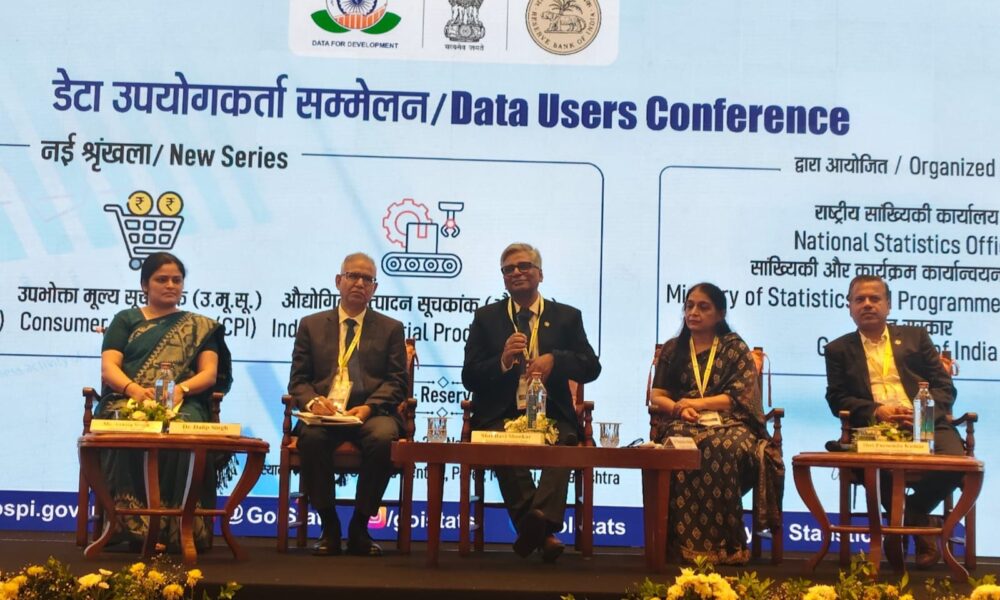
The Ministry of Statistics and Programme Implementation (MoSPI), in collaboration with the Reserve Bank of India (RBI), organised a Data Users Conference in Mumbai on Monday to explain the methodological changes and improvements introduced in the revised series of Gross Domestic Product (GDP), Consumer Price Index (CPI) and Index of Industrial Production (IIP).
The conference brought together economists, policymakers, representatives of financial institutions, credit rating agencies, industry bodies, research organisations and government officials to discuss the new statistical frameworks and their implications for economic analysis, forecasting and policymaking.
Addressing the inaugural session, MoSPI Secretary Saurabh Garg outlined the Ministry’s priorities following the completion of the base revision exercise. These include rebasing Gross State Domestic Product to 2022-23, developing District Domestic Product estimates and preparing for the implementation of the System of National Accounts (SNA) 2025.
The Ministry is also working on satellite accounts for emerging sectors such as the space, culture, digital and city economies, alongside the development of the Index of Services Production and updating national industrial and product classifications.
RBI Deputy Governor Poonam Gupta highlighted the importance of the revised statistical series in capturing changes in India’s economic structure, consumption patterns and sources of growth. She noted that the new GDP series incorporates double deflation and wider use of administrative data, while the revised CPI series includes updated consumption weights and improved measurement of core inflation.
She also emphasised the importance of regular engagement between data users and statistical authorities to ensure transparency and predictability in data revisions.
In his keynote address, former HDFC Chairman Deepak Parekh stressed the importance of reliable and independent statistical institutions. He said economic data plays a crucial role in shaping market sentiment and guiding decisions by banks, businesses and policymakers. He also highlighted the potential of new data sources and technology, while underlining the need for appropriate safeguards in the use of artificial intelligence.
The conference featured three technical sessions focusing on the revised GDP, CPI and IIP series.
The new GDP series has a base year of 2022-23 and incorporates updated data sources, including the Annual Survey of Unincorporated Sector Enterprises (ASUSE) and Periodic Labour Force Survey (PLFS). It also introduces improvements in measuring manufacturing activity, private consumption expenditure and quarterly national accounts.
The revised CPI series, with base year 2024, incorporates consumption expenditure patterns from the Household Consumption Expenditure Survey 2023-24. It features an updated consumption basket, revised expenditure weights, expanded geographical and market coverage, and the adoption of the COICOP 2018 classification. Greater use of administrative and e-commerce data has also been introduced.
The new IIP series, with base year 2022-23, expands industrial coverage by including water supply, sewerage and waste management, as well as gas supply. It also introduces greater disaggregation in the mining and electricity sectors, revised sectoral weights and provisions for replacing factories that have closed or discontinued production. The use of the Output Producer Price Index for deflation and trial compilation of a chain-linked IIP are among the other improvements.
The RBI also presented its model-based GDP nowcasting framework, which uses around 120 high-frequency indicators, along with its initiatives to improve economic data dissemination through the Database on Indian Economy and the RBIDATA mobile application.
The technical sessions were followed by discussions with participants, who shared feedback and sought clarifications on the revised methodologies and their implications for economic forecasting and policy formulation.
The conference reaffirmed MoSPI’s commitment to improving the understanding and use of official statistics and strengthening India’s statistical framework in support of evidence-based policymaking and the vision of Viksit Bharat 2047.
-PIB




No Comment! Be the first one.