





India poised to lead next biotechnology-driven industrial revolution: Jitendra Singh
India has the potential to lead the next biotechnology-driven industrial revolution, Union Minister of State (Independent Charge) for Science & Technology and Earth Sciences, and Minister of...

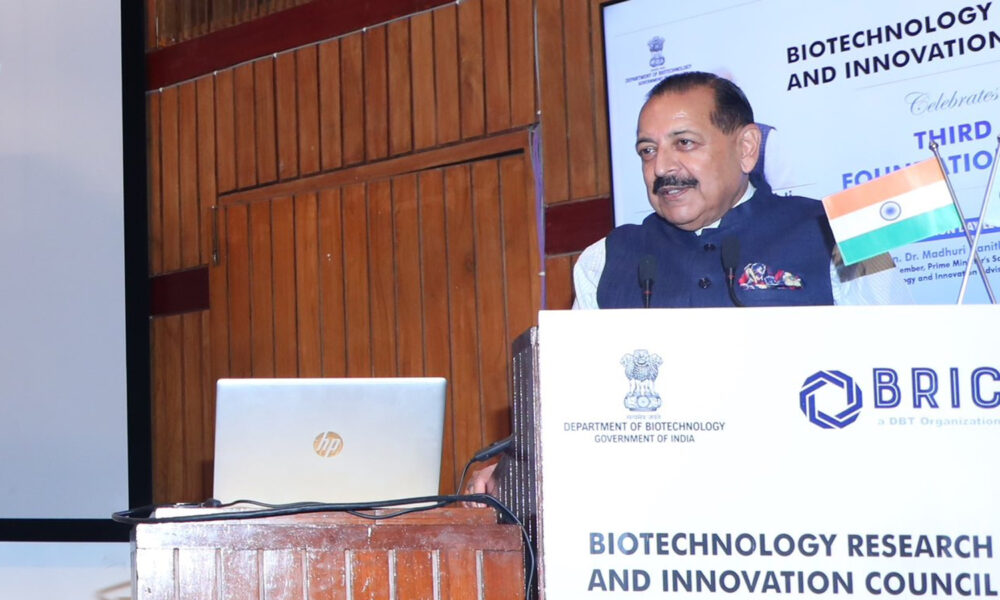
India has the potential to lead the next biotechnology-driven industrial revolution, Union Minister of State (Independent Charge) for Science & Technology and Earth Sciences, and Minister of State in the Prime Minister’s Office, Personnel, Public Grievances and Pensions, the Department of Atomic Energy and the Department of Space, Dr. Jitendra Singh said on Tuesday, calling for stronger industry participation and closer collaboration across the country’s biotechnology institutions.
Addressing the third Foundation Day of the Biotechnology Research and Innovation Council (BRIC) at BRIC–National Institute of Immunology (NII) in New Delhi, the Minister said biotechnology, artificial intelligence and genomics would play a defining role in the next phase of industrial transformation. He urged India’s scientific community to take the lead rather than remain a recipient of technologies developed elsewhere.
Singh said the Government had promoted greater integration among scientific institutions to overcome institutional silos and improve coordination. Describing BRIC as a “joint family”, he said the model enabled institutions to pool resources and collaborate while retaining their individual identities, independence and autonomy.
The integrated structure had also helped reduce procedural delays associated with multiple directorates and approval processes, while creating new opportunities for scientific cooperation, he said. The Minister said other departments and ministries had also adopted similar approaches.
India’s bioeconomy crosses USD 195 billion
Highlighting the expansion of the biotechnology sector, Singh said India’s bioeconomy had grown from approximately USD 10 billion when the present Government took office to more than USD 195 billion. The country’s biotechnology startup ecosystem had also expanded from around 50–60 startups to over 11,000, several of which had the potential to compete globally.
He emphasised the need to strengthen high-performance manufacturing through biomanufacturing hubs, biofoundries and the integration of artificial intelligence into manufacturing processes. Biofoundry hubs in Mohali, Hyderabad, Pune and Thiruvananthapuram were among the initiatives supporting this effort.
The Minister said international partnerships, including the collaboration with the UK’s Centre for Process Innovation, would further strengthen India’s capabilities in biomanufacturing and biofoundry development.
Singh also highlighted the Genomics Centre of Excellence, which has attracted interest from medical institutions, including AIIMS. He said genomics could support the transition towards precision medicine, with institutions beginning to adopt the approach and explore collaborative opportunities.
He also referred to the i3C PhD programme, which provides research scholars opportunities to pursue innovation and collaboration, including through placements in the health and agriculture sectors. Nearly 200 students had benefited from the programme, he said.
Call for greater private-sector participation
Singh said the Government was opening up more opportunities for private-sector participation in science and research, drawing on the experience of reforms in the nuclear sector. He cited the Research, Development and Innovation Fund, the Anusandhan National Research Foundation and BIRAC as important components of India’s wider research and innovation ecosystem.
He said the Prime Minister’s Independence Day appeal to young people to explore opportunities in biotechnology had generated enthusiasm across the sector. The Government was also undertaking outreach initiatives for school students and the public. Recalling his proposal for a dedicated mentorship programme, he highlighted the importance of encouraging more girls to pursue science.
The Minister said India should aim to be at the centre of the next industrial revolution, which would be driven by biotechnology, artificial intelligence and genomics. Unlike previous industrial revolutions that originated elsewhere before India adopted the resulting technologies, the country’s biotechnology community now had an opportunity to shape the next wave of innovation.
Wellcome Trust announces ₹21.7-crore grant
During the Foundation Day event, the Wellcome Trust announced a grant of up to ₹21.7 crore for a five-year immersion training programme covering more than 250 iBRIC+ PhD scholars.
A Letter of Intent was also signed between BRIC and the UK’s Centre for Process Innovation to strengthen India–UK cooperation in biomanufacturing and support the development of biofoundries.
The event also recognised achievements in science and sports. Winners of the Festival of Sports were felicitated, while the iBRIC+ Spotlight Scientist of the Year–2026 awards were presented to Dr Sunil Laxman of BRIC-inStem, Dr Rashna Bhandari of BRIC-CDFD and Professor Bhabatosh Das of BRIC-THSTI.
BRIC aims to connect laboratory research with market applications
Dr Rajesh S. Gokhale, Secretary of the Department of Biotechnology and Director General of BRIC, said the Council’s core vision was to move beyond isolated institutional excellence by bringing together India’s 13 premier biotechnology institutions across 11 cities through a decentralised national network.
He said the network was anchored in the principles of people, culture, trust and resource allocation, and supported by a lean Secretariat and translational initiatives. These included the i3C PhD curriculum and BRIC–BIRAC entrepreneurship programmes.
The Council aims to connect laboratory innovation with market applications, advance sovereign technologies, strengthen food and health security, and establish India as a global biotechnology leader, with long-term economic and societal impact, he said.
The event was attended by Lt. Gen. (Retd.) Dr Madhuri Kanitkar, Member of the Prime Minister’s Science, Technology and Innovation Advisory Council (PM-STIAC) and former Vice-Chancellor of Maharashtra University of Health Sciences; Ekta Vishnoi (IRS), Joint Secretary (Administration), Department of Biotechnology; and Dr Pushkar Sharma, Director, BRIC-NII.
(PIB)
The post India poised to lead next biotechnology-driven industrial revolution: Jitendra Singh appeared first on DD India.





No Comment! Be the first one.