





Bal Vivah Mukt Bharat: Two years of action towards a child-marriage-free India
Child marriage continues to be a major social challenge in India, affecting girls’ health, education, safety and future opportunities. However, the country has made progress in reducing its...

Child marriage continues to be a major social challenge in India, affecting girls’ health, education, safety and future opportunities. However, the country has made progress in reducing its prevalence. According to the National Family Health Survey (NFHS-6), 2023–24, 20.1% of women aged 20–24 years were married before the age of 18, compared with 23.3% in NFHS-5 (2019–21), marking a decline of 3.2 percentage points.
To accelerate this progress, the Ministry of Women and Child Development (MWCD) launched the Bal Vivah Mukt Bharat (BVMB) campaign on November 27, 2024, bringing together legal enforcement, public awareness, institutional coordination and community participation. As the campaign completes two years, its efforts are contributing to the national objective of making India child-marriage-free by 2030.
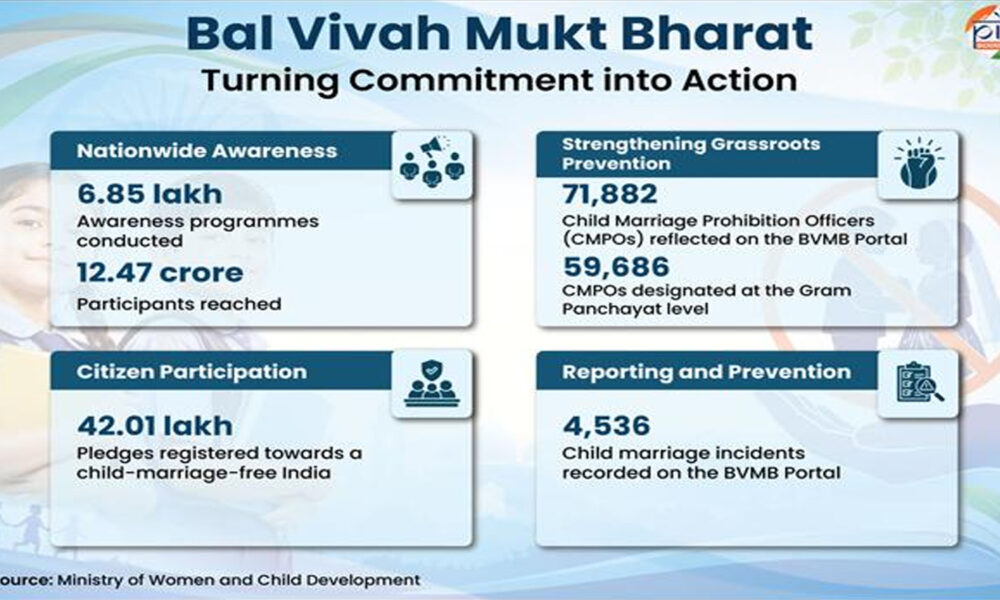
The campaign has conducted 6.85 lakh awareness programmes, reached 12.47 crore participants and registered 42.01 lakh pledges. Its approach combines the legal framework against child marriage with initiatives promoting girls’ education, empowerment and community-level prevention.
Why is eliminating child marriage important?
Child marriage has consequences that extend beyond the early age at which a girl is married. It can expose girls to serious health risks, particularly those associated with early pregnancy, increase their vulnerability to domestic violence and interrupt their education.
The practice also restricts economic opportunities and reinforces cycles of poverty and gender inequality. Girls who leave school early often have fewer opportunities to acquire skills, pursue higher education or participate in the workforce.
The decline in child marriage prevalence from 23.3% to 20.1% between NFHS-5 and NFHS-6 reflects progress, but the continued prevalence of the practice highlights the need for sustained intervention.
India’s response rests on three interconnected approaches: legal safeguards to prohibit and prevent child marriage, programmes that promote the survival, protection and education of girls, and community mobilisation to change social attitudes and encourage timely reporting.
The legal framework: Prohibition of Child Marriage Act, 2006
The Prohibition of Child Marriage Act (PCMA), 2006, provides the statutory foundation for preventing child marriage in India. It replaced the Child Marriage Restraint Act, 1929, commonly known as the Sarda Act, shifting the legal approach towards prohibition, stronger protection and relief for victims.
Who is considered a child under the Act?
A male who has not completed 21 years of age and a female who has not completed 18 years of age are considered children. A marriage in which either contracting party is a child falls within the definition of child marriage.
Legal status of child marriage
A child marriage is generally voidable at the option of the party who was a child at the time of marriage. That person can approach the District Court to have the marriage annulled, generally within two years of attaining majority.
The Act also specifies circumstances in which a child marriage is void, including cases involving trafficking, force, deceit or the use of a child for immoral purposes.
Offences and penalties
Offences under the Act are cognizable and non-bailable. An adult male who marries a child, as well as persons who solemnise, perform, promote, abet or permit a child marriage, can face rigorous imprisonment of up to two years and/or a fine of up to ₹1 lakh. This includes parents and guardians in applicable circumstances. Women offenders are not liable to imprisonment under the Act.
Protection and relief for victims
The Act provides for maintenance and residence for the female contracting party, as well as appropriate custody arrangements for children born from such marriages. Children born from child marriages are considered legitimate.
Preventing marriages before they take place
The law empowers Judicial Magistrates to issue injunctions to stop impending child marriages. District Magistrates and Child Marriage Prohibition Officers (CMPOs) are responsible for preventive action, particularly during mass marriage occasions and festivals such as Akshaya Tritiya.
CMPOs are appointed by State Governments under Section 16 of the Act. Their responsibilities include preventing child marriages, collecting evidence for prosecution, counselling individuals and communities, creating awareness, sensitising communities and submitting periodic reports and statistics.
The emphasis is therefore not limited to taking action after a child marriage has occurred. It also involves identifying risks, mobilising communities and intervening before an illegal marriage takes place.
Supreme Court’s framework for stronger implementation
In its judgment dated October 18, 2024, in Society for Enlightenment and Voluntary Action & Another v. Union of India & Others (W.P. (C) No. 1234 of 2017), the Supreme Court laid down a comprehensive framework for States and Union Territories to strengthen implementation of the Act.
The framework emphasised the appointment of dedicated, full-time CMPOs at district and sub-district levels, along with special units for coordination, monitoring and grievance redressal. It also called for multi-sectoral awareness campaigns, training of key functionaries, technology-enabled reporting and databases identifying areas at risk.
The judgment reinforced the importance of shifting the focus from punishment alone towards prevention, protection and empowerment.
Beti Bachao Beti Padhao: Addressing the social roots of child marriage
While the PCMA provides legal protection, changing the social attitudes that sustain child marriage requires sustained awareness and empowerment of girls.
The Beti Bachao Beti Padhao (BBBP) initiative, launched on January 22, 2015, seeks to address concerns relating to the Child Sex Ratio and promote the survival, protection and education of the girl child.
Led by the Ministry of Women and Child Development, the initiative works with the Ministries of Health and Family Welfare, Education, Skill Development and Entrepreneurship, and Minority Affairs. It is implemented as a component of Mission Shakti.
BBBP focuses on awareness generation, advocacy, community mobilisation and behavioural change. Its objectives are closely connected with preventing child marriage by encouraging girls’ education, addressing school dropouts, challenging discriminatory social norms and promoting the value of the girl child.
Bal Vivah Mukt Bharat builds on this foundation by providing a more focused national campaign for child-marriage prevention, with coordinated action by statutory authorities, institutions and communities.
Bal Vivah Mukt Bharat: A national campaign for collective action
Launched on November 27, 2024, by the Ministry of Women and Child Development, BVMB aims to bring government institutions, State and Union Territory administrations, local bodies, educational institutions, frontline workers, civil society organisations, faith leaders, youth and citizens together around a common national commitment.
The campaign seeks to reduce the prevalence of child marriage through community-level prevention, improve public access to CMPOs, increase reporting of incidents and support girls who are at risk.
Its national objective is to make India child-marriage-free by 2030, in line with Sustainable Development Goal (SDG) Target 5.3, which calls for the elimination of harmful practices, including child, early and forced marriage.
The Ministry has committed to fully funding the campaign, with priority given to 257 high-burden districts identified using NFHS-5 data, where child marriage prevalence is at or above the national average.
The campaign follows a whole-of-government and whole-of-society approach, recognising that legal enforcement alone cannot eliminate a practice sustained by social customs, economic vulnerabilities and entrenched attitudes.
BVMB Portal: Using technology for prevention and monitoring
The BVMB Portal, available at https://stopchildmarriage.wcd.gov.in, serves as the digital backbone of the campaign. It provides a centralised platform for public information, incident reporting, citizen participation and monitoring of activities across States and Union Territories.
Its key functions include:
* Access to CMPO information: Citizens can find details of Child Marriage Prohibition Officers to facilitate reporting and intervention.
* Incident reporting: The portal enables the reporting of child marriage incidents for follow-up by the relevant authorities.
* Monitoring awareness activities: States, Union Territories and field functionaries can record awareness programmes and community mobilisation efforts.
* Citizen pledges: Individuals, institutions and public representatives can take the pledge towards a child-marriage-free India through the portal. The pledge initiative is also facilitated through MyGov.
By bringing these functions together, the portal supports transparency, timely reporting, evidence-based monitoring and coordination among authorities.
The 100-Day Intensive Awareness Campaign
To intensify efforts during the campaign’s second year, the Ministry launched a 100-Day Intensive Awareness Campaign on December 4, 2025, at Vigyan Bhawan, New Delhi, accompanied by a synchronised national pledge-taking ceremony.
Implemented across all States and Union Territories from November 27, 2025, to March 8, 2026, the campaign followed three phases to engage educational institutions, community influencers and local governance bodies.
First phase: Educational institutions (November 27–December 31, 2025)
The first phase focused on schools, colleges and universities. Activities included awareness and sensitisation sessions, debates, essay competitions, interactive programmes and pledge ceremonies. The objective was to engage students and young people in challenging the social acceptance of child marriage.
Second phase: Religious institutions and community influencers (January 1–31, 2026)
The second phase involved religious institutions, faith leaders, community influencers and marriage-related service providers. Outreach activities included engagement with temples, mosques and other places of worship, as well as caterers, tent houses, DJs and other service providers associated with marriage ceremonies.
Information, Education and Communication (IEC) materials were used to spread awareness and encourage community stakeholders to prevent child marriages.
Third phase: Panchayats and urban local bodies (February 1–March 8, 2026)
The final phase focused on Gram Panchayats and municipal wards. It aimed to strengthen community mobilisation and facilitate resolutions declaring Panchayat and ward jurisdictions child-marriage-free.
The campaign was implemented through coordination among Central Ministries and Departments, State and Union Territory Governments, district administrations and institutional and community-level stakeholders. It encouraged Panchayati Raj Institutions, Urban Local Bodies and local communities to take an active role in prevention and monitoring.
Bal Vivah Mukt Bharat: Key achievements after two years
The campaign has expanded awareness, strengthened the institutional framework and encouraged citizens to participate in the movement against child marriage.
Large-scale awareness and community outreach
A total of 6.85 lakh awareness programmes have been conducted across the country, reaching 12.47 crore participants through awareness and mobilisation activities.
The 100-Day Intensive Awareness Campaign provided a structured approach to engaging students, educational institutions, religious leaders, marriage-related service providers, Panchayati Raj Institutions, Urban Local Bodies and local communities.
Strengthening the institutional framework
The BVMB Portal reflects 71,882 Child Marriage Prohibition Officers, including 59,686 designated at the Gram Panchayat level.
This expansion of the institutional network is intended to strengthen prevention mechanisms at the grassroots and improve public access to officials responsible for addressing child marriage.
Citizen participation through pledges
The campaign has registered 42.01 lakh pledges through the BVMB Portal and MyGov. Of these, 40.96 lakh were registered through the BVMB Portal and 1.05 lakh through MyGov.
The pledge initiative enables citizens, institutions and public representatives to formally express their commitment to preventing child marriage and supporting the national campaign.
Reporting and preventive action
A total of 4,536 child marriage incidents have been recorded on the BVMB Portal.
Focused interventions during high-risk periods, including Akshaya Tritiya, have involved district administrations, CMPOs, law enforcement agencies and community stakeholders. These efforts seek to prevent child marriages through timely reporting, local vigilance and coordinated intervention.
The portal also helps authorities monitor awareness programmes, mobilisation efforts and incident reporting, supporting more systematic follow-up across States and Union Territories.
Progress across States and Union Territories
The national decline in child marriage prevalence from 23.3% in NFHS-5 to 20.1% in NFHS-6 indicates progress, although the pace of improvement varies across regions.
Dadra and Nagar Haveli and Daman and Diu recorded the largest decline, at 10.1 percentage points. This was followed by the Andaman and Nicobar Islands, with a reduction of 7.4 percentage points; Assam, with 6.5 percentage points; Bihar, with 6.2 percentage points; and Tripura, with 6.1 percentage points.
According to the data, 28 States and Union Territories are performing better than the national average. These include Karnataka, Uttar Pradesh, Tamil Nadu, Mizoram and Keralam.
The variations highlight the need for region-specific interventions, particularly in areas where child marriage remains prevalent. Strengthening local institutions, improving access to education and expanding community engagement remain important to achieving more uniform progress.
Two years of BVMB: What lies ahead?
The national observance on November 27, 2026, marks two years of the Bal Vivah Mukt Bharat campaign. It provides an opportunity to assess progress, recognise the contribution of CMPOs and grassroots stakeholders, and share successful practices across States and Union Territories.
The next phase of the campaign will require continued attention to several priorities strengthening dedicated CMPO arrangements at district and grassroots levels; improving the quality and completeness of data on the BVMB Portal; expanding awareness programmes and citizen pledge mobilisation; ensuring timely reporting and preventive intervention in cases of child marriage; deepening the participation of Panchayats, urban local bodies, educational institutions, families, faith leaders, youth and civil society organisations; and providing stronger support to girls at risk through education, protection and empowerment initiatives.
The NFHS figures show that child marriage prevalence is declining, but the practice has not been eliminated and progress remains uneven across States and Union Territories.
The larger goal of Bal Vivah Mukt Bharat is to make the prevention of child marriage a shared social responsibility rather than solely a matter of legal enforcement. By combining the Prohibition of Child Marriage Act, Beti Bachao Beti Padhao, digital reporting, institutional coordination and community participation, the campaign seeks to accelerate progress towards a child-marriage-free India by 2030 and fulfil the commitment under SDG Target 5.3.
(PIB)
The post Bal Vivah Mukt Bharat: Two years of action towards a child-marriage-free India appeared first on DD India.



No Comment! Be the first one.