





Uniform, Motherhood and Kargil: The Radiant Story of Captain Yashika Hatwal Tyagi
One by one, the studio lights came on. The cameras were set in place, and amid the quiet bustle on the floor there was a different kind of stillness. The “Tejaswini” team was waiting for...

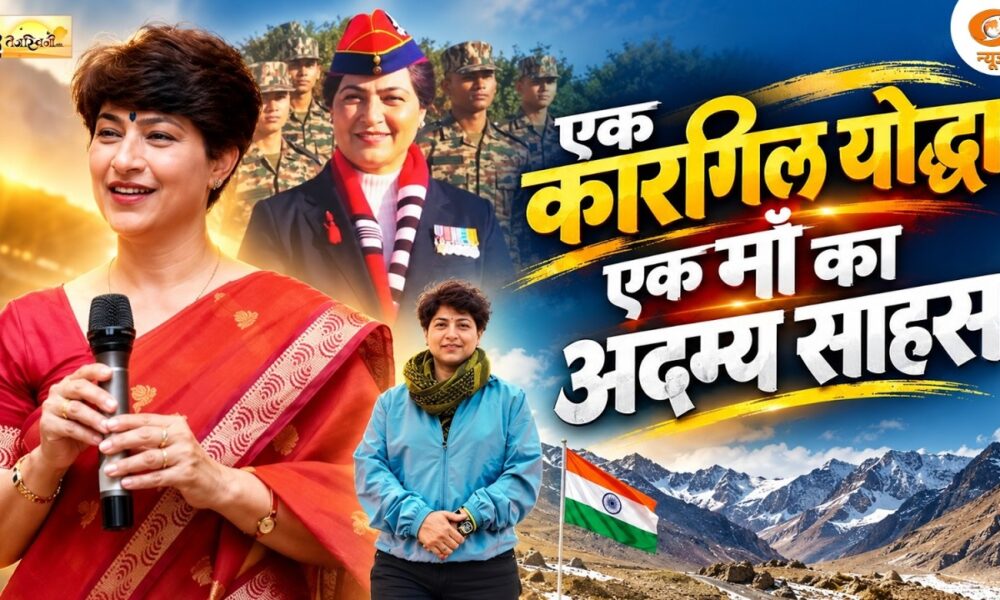
One by one, the studio lights came on. The cameras were set in place, and amid the quiet bustle on the floor there was a different kind of stillness. The “Tejaswini” team was waiting for a guest whose story had not come from a field or a stage, but from the harsh days of the Kargil War.
Soon the studio door opened. She walked in with a steady stride and an easy smile, and in her eyes was the same discipline that has not faded even years after she took off the uniform. She shook hands warmly with everyone, had her microphone fitted, and sat down.
We had only one question in mind: where do you begin a conversation with a woman who lives so many roles at once—daughter, mother, wife and army officer?
The call of “Roll… camera… action” rang out. Silence fell over the studio, and the conversation began at the very point where her life had taken a turn.
This is the story of Captain Yashika Hatwal Tyagi.
A Grief That Changed the Purpose of Her Life
One day, an Army truck stopped at the door of her home. In it lay the mortal remains of her father, a colonel who had served the nation in several wars. Seven-year-old Yashika watched her father, draped in the tricolour. There were tears in her eyes and immense sorrow in her heart, but in the midst of that grief, a resolve was taking shape: one day she, too, would wear the Indian Army’s uniform, just like her father.
Even after losing her father, her resolve never weakened. As soon as the Army opened the path for women to become officers, she trained at the Officers Training Academy, Chennai. At the passing-out parade, she commanded her contingent and won a silver medal for merit. She was commissioned into the Army Service Corps, the Army’s logistics branch.
From Dreams to Snow-Covered Peaks
Captain Yashika’s first posting was in the Northeast. It was during this time that she married a fellow Army officer. Some time later she became a mother, yet her determination to advance in the Army remained undiminished alongside her family responsibilities.
She then chose a posting in Leh. In this difficult terrain of extreme altitude, thin oxygen and sub-zero temperatures, her body struggled at first, but gradually she adapted to the environment. She became one of the first women officers to be posted in the region.
The Warning Signs of Kargil and the Memory of Two Heroes
Her tenure in Leh was about to end when news of the intrusion in Kargil began to arrive. Tension in the border areas was rising rapidly, and the Indian Army was facing a major challenge.
Recalling those days, Captain Yashika never forgets two names: Captain Saurabh Kalia and Squadron Leader Ajay Ahuja.
Captain Saurabh Kalia, a native of Palampur in Himachal Pradesh, was an officer of the Jat Regiment. He had set out on patrol in the Kaksar sector with his men when Pakistani soldiers took them captive. Several weeks later, his body was handed over to India, bearing serious marks of torture. The incident sparked outrage across the country.
Soon afterwards, Squadron Leader Ajay Ahuja of the Indian Air Force was on a mission over the Batalik sector when his MiG aircraft was hit by an enemy missile. He ejected safely and was descending by parachute when Pakistani soldiers opened fire on him. The post-mortem found bullet wounds on his body. The Government of India lodged a strong protest with Pakistan, calling it a flagrant violation of the Geneva Convention and international law. Squadron Leader Ajay Ahuja was posthumously awarded the Vir Chakra.
According to Captain Yashika, the sacrifice of these two heroes was both a source of pain and a source of resolve for everyone posted at the front.
The Kargil War: Husband in Operation Vijay, and a Woman’s Three Fronts
During the Kargil War, Captain Yashika’s challenges were not limited to her military duties. She was in the second trimester of her pregnancy, and her one-and-a-half-year-old son was with her. Her husband was part of Operation Vijay and was posted in the Drass sector, in the thick of the war.
With every piece of news from Drass, her heart raced as a wife. She had a small child to care for and the responsibility of the child yet to come. But as an Army officer, her focus never strayed from her work.
As an officer of the Army Service Corps, it was her responsibility to ensure that weapons, rations and other essential supplies reached the soldiers on the forward posts on time. Amid icy mountains and punishing conditions, her work was part of the strong system that enabled the soldiers at the front to keep fighting.
India won the Kargil War. Soon after the war, Captain Yashika gave birth to her second son.
Farewell to the Uniform, but the Journey of Service Continues
In recognition of her service, she was honoured with several medals, including the Operation Vijay Star. She also became the first woman officer to receive a Battle Report.
At that time, there was no provision for permanent commission for women officers, so she had to leave the Army. The uniform came off, but her drive to do something for the country and society did not diminish. Today, as a leadership trainer and motivational speaker, she teaches young people, especially young women, the importance of confidence, discipline and leadership.
Her husband continued his service in the Army, and both of her sons are progressing in their respective careers.
From National Honour to the Kartavya Path
For her contribution to society and women’s empowerment, President Droupadi Murmu conferred on her the “Asmita Icon” award.
Republic Day, 26 January 2023, became another historic moment in her life. On the Kartavya Path, aboard the tableau of the Directorate of Indian Army Veterans, she became the first woman veteran to salute the President. The uniform she had seen as a child on her father’s mortal remains was the same one in whose honour she now stood before the nation’s supreme constitutional head.
She has shared her experiences on major platforms, from the Times Now National Defence Conclave to the Lok Bhavan of Uttarakhand. On 10 October 2026, she also took part as a speaker in the event “Deep-Tech 2030: Building Technology for the Mountain.”
For wars are not won by guns and bullets alone. Victory is also built by the hands that carry essential supplies to the front, and by the hearts that carry out their duty amid worry for their loved ones. The story of Captain Yashika Hatwal Tyagi is a shining example of this courage, motherhood and dedication.
And her journey of service to the nation continues unabated…
The post Uniform, Motherhood and Kargil: The Radiant Story of Captain Yashika Hatwal Tyagi appeared first on DD India.

No Comment! Be the first one.