





Aditya-L1 Uncovers Asymmetric Expansion of Solar Eruption, Offers New Insights into Space Weather
India’s first space-based solar observatory, Aditya-L1, has provided new insights into the expansion of solar eruptions, with observations revealing that Coronal Mass Ejections (CMEs) do not...

India’s first space-based solar observatory, Aditya-L1, has provided new insights into the expansion of solar eruptions, with observations revealing that Coronal Mass Ejections (CMEs) do not always expand uniformly as previously believed.
The findings could improve scientific understanding of space weather and help assess potential disruptions to satellites, communication networks and other space-based infrastructure.
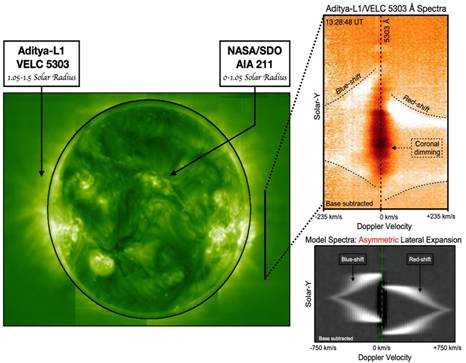
Scientists from the Indian Institute of Astrophysics (IIA), an autonomous institution under the Department of Science and Technology, reconstructed the three-dimensional geometry and dynamics of a solar eruption by combining observations from Aditya-L1’s Visible Emission Line Coronagraph (VELC), NASA’s Solar Dynamics Observatory (SDO) and advanced 3D modelling.
The study, published in the Astrophysical Journal Letters, found that the observed CME did not expand outward from the Sun as a symmetrical bubble. Instead, it exhibited non-uniform expansion, developing an asymmetric shape.
The research examined a CME that occurred on August 5, 2024, originating from an active region near the western limb of the Sun. VELC’s spectroscopic observations detected distinct blueward and redward shifts in emission, indicating plasma moving towards and away from the observer, respectively.
While images from NASA’s SDO captured the CME’s propagation across the sky, Aditya-L1’s VELC provided information about the motion of the expanding plasma towards and away from the observer. Together, the observations enabled scientists to reconstruct the eruption’s three-dimensional structure.
The researchers also developed a three-dimensional geometric-kinematic model to understand the unusual spectral patterns. The model showed that an inclined CME axis combined with asymmetric lateral expansion could explain the observed features, while a model assuming uniform expansion could not reproduce the data.
Aditya-L1, launched in September 2023, is positioned at the Sun-Earth L1 point and provides continuous observations of the Sun. The spacecraft carries seven scientific payloads, with VELC serving as its primary payload.
Designed to observe the solar corona, VELC studies the early stages of CMEs through spectroscopy in the 530.3-nanometre green emission line, produced by highly ionised iron atoms in the corona. This enables scientists to study the hot coronal plasma and measure its movement through Doppler shifts.
The instrument was designed and developed by the Indian Institute of Astrophysics at its MGK Menon Laboratory for Space Sciences on the CREST campus in Hosakote, with substantial support from ISRO.
Scientists say the asymmetric expansion of CMEs could influence their speed and interaction with the solar wind as they travel through the heliosphere. These factors may affect the timing of their arrival at Earth and the intensity of potential space-weather disturbances.
-Pib
The post Aditya-L1 Uncovers Asymmetric Expansion of Solar Eruption, Offers New Insights into Space Weather appeared first on DD India.




No Comment! Be the first one.