




Women-led development under PM Modi is empowering India’s economic future
India’s journey towards becoming a developed nation is increasingly being shaped by the economic participation, entrepreneurial spirit and professional achievements of its women. Under the leadership...

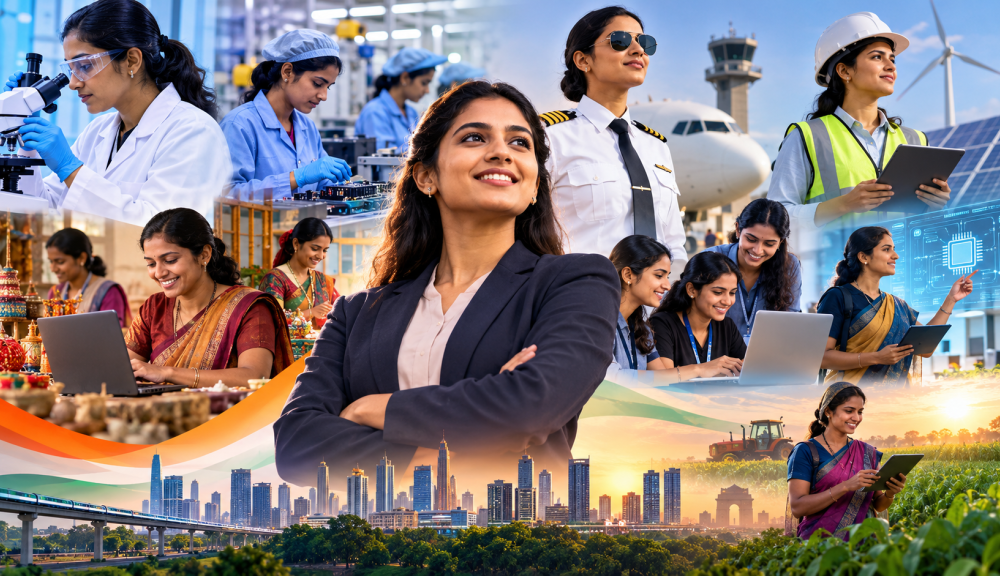
India’s journey towards becoming a developed nation is increasingly being shaped by the economic participation, entrepreneurial spirit and professional achievements of its women. Under the leadership of Prime Minister Narendra Modi, women’s empowerment has gained a stronger economic dimension, with policy initiatives focusing not merely on bringing women into the workforce but also on enabling them to become entrepreneurs, skilled professionals, innovators and leaders. This approach reflects the vision of Viksit Bharat, in which women are not just beneficiaries of development but active partners in building the nation.
The latest figures on women’s employment underline the scale of this transformation. According to the Periodic Labour Force Survey (PLFS), the Female Labour Force Participation Rate (LFPR) for women aged 15 years and above increased from 23.3 percent in 2017-18 to 40 percent in 2025. The Worker Population Ratio (WPR) rose from 22 percent to 38.8 percent during the same period. An estimated 20 crore women aged 15 years and above were employed in India in 2025. These figures point to expanding economic opportunities and the growing contribution of women to the country’s productive capacity.
A significant feature of the government’s approach is its emphasis on entrepreneurship and enterprise creation. As of October 2026, approximately 3.69 crore registered micro, small and medium enterprises were women-owned, accounting for around 38 percent of all registrations. By March 2026, more than 1.07 lakh recognised startups had at least one woman director or partner, representing approximately 48 percent of recognised startups. These developments highlight women’s growing presence in business ownership and innovation.
The government’s support for women-led enterprises extends from formal recognition to finance, mentoring and market access. The Swavalambini Scheme, launched as a pilot in February 2025, supports young women through entrepreneurship training, financial and market guidance, legal assistance and 21 weeks of mentorship. Meanwhile, the Yashasvini Campaign has facilitated more than 22 lakh women-owned MSME registrations as of July 2026. In the financial year 2025-26, procurement from women-owned micro and small enterprises reached 3.8 percent, exceeding the stipulated public procurement target of 3 percent.
Access to credit has been another important pillar of this strategy. Under the Pradhan Mantri MUDRA Yojana, more than 57.79 crore loans had been sanctioned by April 2026 since the scheme’s inception in 2015, with women entrepreneurs accounting for two-thirds of the total loans. This access to collateral-free credit can help women establish small businesses, strengthen existing enterprises and pursue economic independence.
Support for women-led startups is also expanding. As of January 2026, alternative investment funds supported under the Fund of Funds for Startups had invested approximately 2,995 crore rupees in women-led startups from 2025 onwards. Incubators supported by the Startup India Seed Fund Scheme had approved around 294 crore rupees for women-led startups. Such initiatives are important for helping women move beyond traditional occupations into innovation-driven businesses.
Market access completes this support system. Through the Womaniya initiative on the government e-Marketplace, women-owned enterprises and self-help groups can connect with government buyers. By July 2026, more than 2.17 lakh women-owned micro and small enterprises were registered on GeM. During 2025-26, the total contract value awarded to women-owned MSEs exceeded ₹28,000 crore, registering 27.6 percent growth over the previous year. Women received 5.6 percent of the total order value, surpassing the mandated procurement target of 3 percent.
Equally encouraging is women’s growing participation in technology and specialised professions. As of July 2026, women constituted nearly 70 percent of the direct workforce in mobile phone manufacturing. They accounted for approximately 25 percent of the semiconductor workforce as of March 2025. In civil aviation, women represented 15 percent of pilots in India, while their participation in STEM research careers increased to 29 percent in 2023-24, compared with 13 percent in 2000-01.
The emphasis on future-ready skills further strengthens this transformation. Initiatives such as NAVYA, AI Careers for Women and WISE-KIRAN seek to widen access to emerging technologies, scientific research and specialised careers. These programmes can help women acquire relevant skills and participate in sectors that will shape India’s future economy.
Workplace safety and social protection are equally essential. The consolidated Labour Codes provide for maternity benefits, safeguards against gender discrimination and opportunities for women to work night shifts with their consent and prescribed safeguards. Such provisions recognise that employment opportunities must be supported by conditions that allow women to work with dignity and security.
Ultimately, women’s economic empowerment is both a social imperative and an economic necessity. By strengthening access to finance, skills, entrepreneurship, markets and safer workplaces, the Modi government is pursuing a development model that seeks to expand women’s choices and productive participation. However the challenge ahead is to ensure that rising workforce participation translates into better incomes, secure employment and sustainable opportunities across regions and social groups. Nevertheless, the progress reflected in these figures demonstrates the growing importance of women in India’s economic landscape.
Prime Minister Modi’s emphasis on women-led development offers a powerful framework for the next phase of national growth. When women have the resources and opportunities to shape their own economic futures, the benefits extend to families, communities, industries and the nation. Empowering women to lead, innovate and prosper will therefore remain central to India’s ambition of building a confident, inclusive and developed Viksit Bharat.



No Comment! Be the first one.