



India Targets 600 Million Tons of Steel by 2047, Sri Lanka’s Ports Turn Strategic, and Pilot Demand Soars
Inside This Week’s Economic Brief This week’s Economic Brief covers India’s draft National Steel Policy targeting 600 million tons by 2047, Sri Lanka’s Colombo-Hambantota maritime strategy, and...

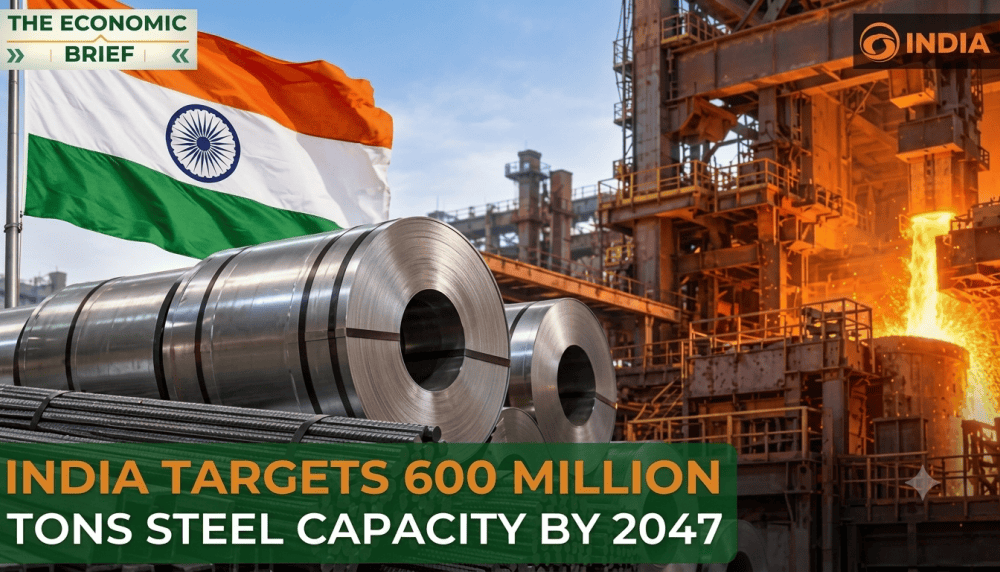
Table Of Content
Inside This Week’s Economic Brief
This week’s Economic Brief covers India’s draft National Steel Policy targeting 600 million tons by 2047, Sri Lanka’s Colombo-Hambantota maritime strategy, and India’s surging demand for commercial pilots.
This week’s edition of The Economic Brief on DD India examined three major stories: India’s ambitious new draft National Steel Policy, Sri Lanka’s emergence as a pivotal maritime hub amid great-power competition, and soaring pilot demand in India’s booming aviation sector. The episode featured Principal Secretary to the Prime Minister Shaktikanta Das, Steel Secretary Sandeep Poundrik, Sri Lanka’s Deputy Defence Minister Aruna Jayasekara, and Dr. Jaswant Singh Kain of the Centre for Maritime Economy and Connectivity at RIS.
Global South’s Rising Role in the World Economy
Shaktikanta Das warned that trade policy uncertainty, geopolitical tensions, and climate shocks pose material risks to global growth, but noted that Global South economies, led by India, have steadily increased their share of the world economy, with combined output expanding nearly six-fold since 2000.
India Unveils Draft National Steel Policy Targeting 600 Million Tons by 2047
Steel Secretary Sandeep Poundrik announced a new draft steel policy that doubles India’s current 2030 target of 300 million tons to 600 million tons of steelmaking capacity by 2047 — described as a conservative estimate. India’s current capacity stands at around 220 million tons, meaning the new policy effectively aims to nearly triple it. Key elements include:
- Decarbonization, cutting emission intensity from 2.54 to 1.54 tons of CO2 per ton of steel through better technology and best practices among small producers.
- Raw material security, with iron ore demand projected at 772 million tonnes and coking coal at 214 million tonnes, alongside efforts to acquire overseas mining assets as Tata Steel, JSW Steel, and Jindal already have.
- A ₹5,000 crore scheme, Viksit Bharat Ispat, offering small producers incentives linked to emissions reduction through better technology and raw materials.
- Specialty steel development, with 175 projects underway for aerospace, defense, automotive, high-speed rail, and corrosion-resistant maritime applications.
- Trade protection, including anti-dumping duties on flat steel products targeting subsidized surplus steel from China, Vietnam, and Nepal.
Poundrik said the revised policy accounts for issues largely absent from the 2017 framework, including AI, machine learning, and decarbonization, as India has become the world’s fastest-growing major steel producer by both capacity and consumption.
https://www.youtube.com/watch?v=fvN0g1OF9eE&t=39s
Sri Lanka’s Ports Emerge as Strategic Maritime Hubs
Sri Lanka’s Deputy Defence Minister Aruna Jayasekara affirmed the country will maintain neutrality and ensure its territory is never used against any regional nation, while stressing maritime domain awareness as central to its geostrategic value. Sitting on a corridor carrying more than 60% of global container traffic, with 200 to 300 ships passing daily, Colombo remains a leading South Asian transshipment hub while Hambantota is positioned as a deepwater zone capable of hosting the world’s largest vessels.
Dr. Jaswant Singh Kain noted that China’s 99-year lease of Hambantota underscored the risks of debt diplomacy, while India’s $4 billion assistance after Sri Lanka’s 2022 economic collapse has strengthened ties, with Colombo now committed to neutrality rather than allowing any country to be used against another in the region. He pointed to India’s Maritime Amritkal Vision 2047, the Sagar Mala project, and 14 coastal economic zones as part of an ambitious blue economy push, noting the sector contributes about 4% of India’s GDP versus roughly 10% of Sri Lanka’s, with both countries targeting significant growth by 2030.
https://www.youtube.com/watch?v=u6uq3OY7iqQ&t=540s
India’s Aviation Sector Drives Surging Pilot Demand
India accounts for roughly 3% of the global commercial pilot workforce but is the world’s fastest-growing pilot market, with between 11,400 and 13,989 pilots actively employed across major airlines and around 25,000 total licensed pilots. The Ministry of Civil Aviation projects demand for approximately 30,000 pilots over the next decade. Annual commercial pilot license issuance rose from 640 in 2018 to 1,652 in 2025, with 11 new flying training organizations approved in August. India also has the highest proportion of female commercial pilots globally, at over 15% versus a global average of nearly 4%.
https://www.youtube.com/watch?v=AuO8nd7d718
Key Takeaways
India’s new steel policy signals a long-term push toward decarbonized, globally competitive capacity nearly tripling current output. Sri Lanka’s strategic ports are becoming central to Indian Ocean geopolitics, with India positioning itself as a stabilizing alternative to Chinese debt diplomacy. And India’s aviation sector is scaling its pilot workforce rapidly to match the world’s fastest-growing air travel market.




No Comment! Be the first one.