




India’s industrial production grows 8% in August, manufacturing and electricity lead expansion
India’s industrial production recorded a strong year-on-year growth of 8.0 per cent in August 2026, driven by robust expansion in the manufacturing and electricity sectors, according to the Quick...

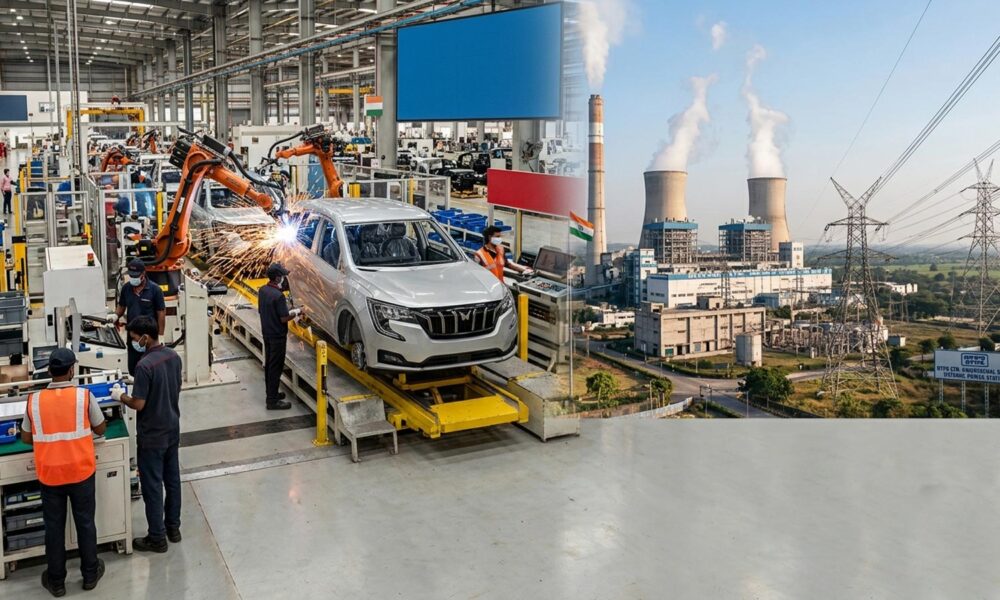
India’s industrial production recorded a strong year-on-year growth of 8.0 per cent in August 2026, driven by robust expansion in the manufacturing and electricity sectors, according to the Quick Estimates of the Index of Industrial Production (IIP) released by the Ministry of Statistics and Programme Implementation (MoSPI) on Monday.
The IIP growth accelerated from 6.7 per cent in July 2026. The overall IIP index rose to 123.3 in August 2026 from 114.2 in the same month last year.
The manufacturing sector grew 9.0 per cent in August, while electricity and gas supply registered a growth of 12.3 per cent. Water supply, sewerage and waste management grew 6.3 per cent. Mining and quarrying, however, contracted 5.6 per cent during the month.
The manufacturing sector has recorded growth of 8 per cent or more for three consecutive months, marking a strong run of industrial activity.
Manufacturing drives industrial growth
Within the manufacturing sector, 18 of the 23 industry groups at the two-digit level of the National Industrial Classification (NIC-2025) recorded positive growth in August 2026 compared with August 2025.
The three largest positive contributors were manufacture of electrical equipment, which grew 30.9 per cent, manufacture of other transport equipment, which grew 25.3 per cent, and manufacture of motor vehicles, trailers and semi-trailers, which grew 25.2 per cent.
The motor vehicles industry saw significant contributions from auto components, spares and accessories, passenger cars and commercial vehicles.
In electrical equipment, growth was supported by electrical apparatus used for switching or protecting electrical circuits, including switchgear, circuit breakers, switches and control or meter panels, as well as end-face connectors for optical fibres and cables, UPS and solid-state drives.
The other transport equipment segment was supported by two-wheelers, railway rolling stock and related parts, maintenance or service vehicles, as well as parts and accessories of motorcycles, mopeds and sidecars.
Among other major manufacturing segments, computer, electronic and optical products grew 19.3 per cent, rubber and plastics products 21.4 per cent, fabricated metal products 16.9 per cent, machinery and equipment 10.3 per cent, and other non-metallic mineral products 11.4 per cent.
Textiles grew 13.1 per cent, beverages 18.3 per cent, furniture 9.4 per cent and leather and related products 8.1 per cent.
However, tobacco products declined 8.0 per cent, wearing apparel fell 7.4 per cent, chemicals and chemical products declined 0.5 per cent, and pharmaceuticals, medicinal chemical and botanical products fell 1.6 per cent during the month.
Mining remains a drag
The mining and quarrying sector recorded a 5.6 per cent contraction in August, with the sectoral index falling to 85.7 from 90.8 a year earlier.
Fuel minerals declined 5.7 per cent and non-metallic minerals fell 12.8 per cent, while metallic minerals, including rare earth minerals, grew 5.0 per cent.
During April-August 2026, mining and quarrying contracted 2.0 per cent compared with the corresponding period of the previous year.
Electricity output rises sharply
The electricity and gas supply sector recorded 12.3 per cent growth in August, with its index rising to 133.9 from 119.2 a year earlier.
Electricity generation grew 13.3 per cent, with generation from renewable sources increasing 15.4 per cent and non-renewable sources rising 12.3 per cent. Gas supply, however, declined 2.4 per cent.
The water supply, sewerage and waste management sector grew 6.3 per cent. Water supply increased 4.5 per cent, while sewerage and waste management rose 8.8 per cent.
Capital and intermediate goods show strong growth
The use-based classification showed broad-based expansion across most categories in August.
Capital goods recorded the strongest growth at 16.9 per cent, followed by intermediate goods at 13.7 per cent and consumer durables at 11.1 per cent.
Infrastructure and construction goods grew 6.4 per cent, while primary goods increased 3.5 per cent and consumer non-durables rose 2.1 per cent.
The indices for August stood at 140.7 for capital goods, 131.8 for intermediate goods, 132.5 for infrastructure and construction goods, 129.4 for consumer durables, 114.3 for consumer non-durables and 111.8 for primary goods.
Intermediate goods, capital goods and consumer durables were the top three positive contributors to overall IIP growth during the month.
April-August industrial growth at 6.7%
For the April-August period of 2026-27, the overall IIP grew 6.7 per cent compared with the corresponding period of 2025-26.
Manufacturing growth during the period stood at 7.4 per cent, while electricity and gas supply grew 9.5 per cent. Water supply, sewerage and waste management increased 6.4 per cent. Mining contracted 2.0 per cent.
Under the use-based classification, capital goods recorded 16.3 per cent growth during April-August, followed by intermediate goods at 10.0 per cent and consumer durables at 9.4 per cent. Infrastructure and construction goods grew 7.3 per cent, primary goods 3.4 per cent and consumer non-durables 1.2 per cent.
July IIP undergoes final revision
Along with the August 2026 Quick Estimate, the indices for July 2026 were revised based on updated production data received from source agencies.
The Quick Estimates for August were compiled at a weighted response rate of 88.0 per cent, while the final revision for July was based on a weighted response rate of 93.4 per cent.
MoSPI said the Quick Estimates are subject to revision in subsequent releases in accordance with the revision policy of the IIP, which is compiled using data received from source agencies that collect information from producing factories and establishments.
The IIP has a base year of 2022-23 and covers four broad sectors – mining and quarrying, manufacturing, electricity and gas supply, and water supply, sewerage and waste management.
The release of IIP data for September 2026 is scheduled for October 28, 2026.






No Comment! Be the first one.