




Development must not destroy heritage that gives identities to citizens, communities: Shekhawat
Development must not destroy the very heritage that gives identities to citizens and communities, Union Culture Minister Gajendra Singh Shekhawat said on Monday, as he pitched for giving cultural...

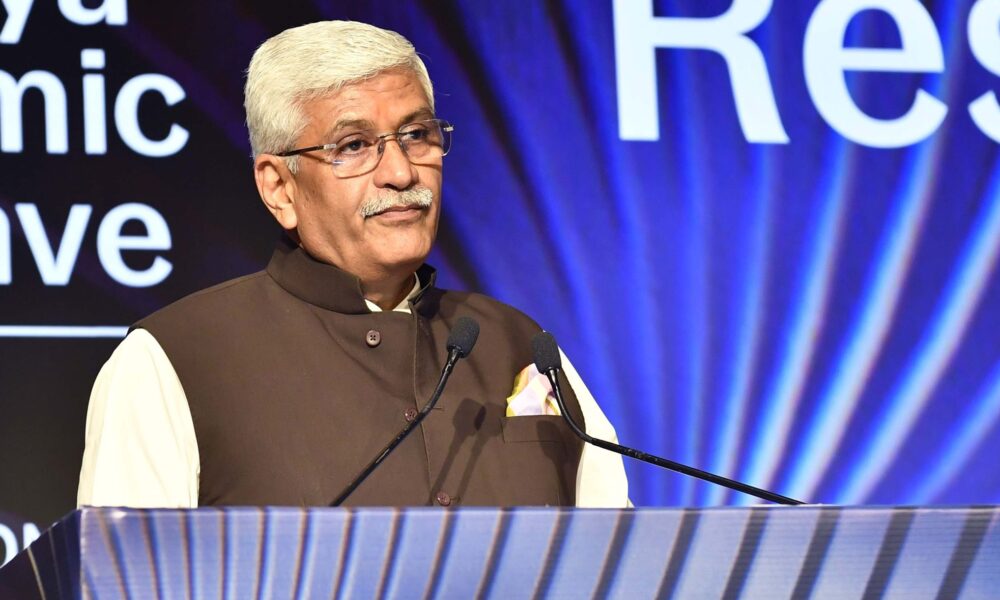
Development must not destroy the very heritage that gives identities to citizens and communities, Union Culture Minister Gajendra Singh Shekhawat said on Monday, as he pitched for giving cultural capital its “rightful place” in the architecture of economic policy.
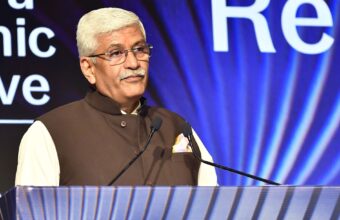
In his keynote address at Kautilya Economic Conclave — a gathering of financial policymakers and experts — in Delhi, he further said, “We must create a model in which development protects heritage, and heritage enriches development.”
He spoke at the session under the theme ‘Culture as Capital: From Heritage to Horizons’ and shared the dais with noted economist N K Singh and British-Indian peer Lord Karan Bilimoria.
Shekhawat, also the Union Tourism Minister, underlined the value of India’s rich cultural heritage in contributing as a growth engine for its economy and asserted that modernity must go hand in hand with “civilisational confidence”.
“At an economic forum like this, we must broaden our vocabulary of development. We speak rightly of physical capital, financial capital, human capital and technological capital. But we must give cultural capital its rightful place in the architecture of economic policy,” he said.
He recalled Prime Minister Narendra Modi’s address at the G20 Culture Ministers’ Meeting in Varanasi in 2023, saying he articulated this principle with great clarity when he had described heritage as an “important asset for economic growth and diversification”.
“I believe that the time has come to take that insight a decisive step further. We must make cultural capital an integral part of our economic imagination,” the Union minister said.
“For too long, we have been presented with a false choice — either development or heritage. I do not believe that India needs a choice. Our objective must be, as our prime minister often says, development with heritage,” Shekhawat said, referring to Modi’s ‘Vikas Bhi, Virasat Bhi’ slogan.
He asserted that development must not destroy the very heritage that gives our citizens and communities their identities and that heritage must not become an obstacle to legitimate aspirations for growth and prosperity.
The task, therefore, is to make them “mutually reinforced”, he said.
“We must create a model in which development protects heritage and heritage enriches development. This is not nearly a cultural ideal. It is a more sustainable model of economic growth,” he said.
In his nearly 25-minute address, Shekhawat further said a government can provide infrastructure, policy, standards, financial mechanisms, technology platforms, core infrastructure and institutional frameworks, but culture ultimately lives in a society.
“It lives in communities, it lives in organisations, it lives in families, it lives in the hands of artisans, it lives in the imagination of artists, it lives in our universities and museums,” he added.
He also pitched for all stakeholders to come together and join hands with the government to build a “cultural economy”.
“The cultural economy cannot be built by a government alone. We need government and industry, universities and museums, technology companies, and other institutions, hospitality enterprises, and local communities, entrepreneurs, and artisans, economists and cultural practitioners,” Shekhawat said.
Each brings a different capability; together, they can create an ecosystem far more powerful than any one institution could create by itself, he said.
While emphasising the “extraordinary civilisational wealth” inherited by India, he underlined that the “greatest question before us is, not what have we inherited”.
“The greater question is, what we are going to create from that inheritance,” the minister said.
“Are our ambitions finding larger markets, or our young artists reaching new audiences, or our manuscripts opening new frontiers of research, or our heritage cities generating local employment, are our museums becoming centres of learning and innovation, or our cultural relationships opening new avenues of international cooperation? These are the questions by which the economic success of our cultural capital should ultimately be judged,” he said.
The flagship event’s theme was ‘Resilience in an Age of Flux’.
Shekhawat said resilience is often understood as an ability to adapt to change.
“But resilience has another deeper meaning. It is also the ability to remain anchored while the world around us is changing. A tree grows tall because its roots run deep. A civilisation endures because it possesses both the confidence to embrace change and wisdom to remain, retain continuity,” the Union minister asserted.
And India possesses that “rare civilisation advantage”, he said.
“We can become modern without becoming rootless. We can become digital without becoming disconnected. We can become globally competitive without surrendering our identity. Indeed our greatest strength may lie precisely in our ability to combine modernity with civilisational confidence,” he said.
Shekhawat emphasised that “our heritage must not be seen as an anchor that holds India back”.
“It can become the foundation from which India moves forward. Therefore, culture is not merely a cost centre. It is a capital asset. Heritage is not merely a memory. It is an economic and social resource,” he said.
Shekhawat also pitched for enlarging the understanding of culture. “We must begin to regard culture not merely as a heritage which need to be preserved. But, as a capital to be captured and monetised,” he said.
-PTI
The post Development must not destroy heritage that gives identities to citizens, communities: Shekhawat appeared first on DD India.


No Comment! Be the first one.