




India will safeguard security and strategic autonomy when threatened: Rajnath Singh
Defence Minister Rajnath Singh on Sunday said India does not seek to occupy the territory of any country but will firmly safeguard its security and strategic autonomy when threatened, while asserting...

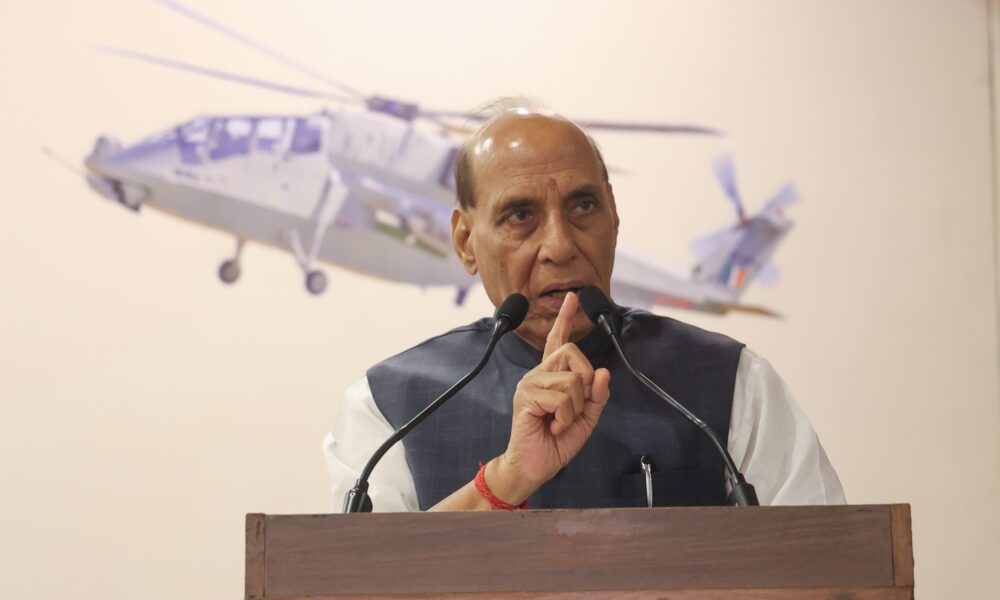
Defence Minister Rajnath Singh on Sunday said India does not seek to occupy the territory of any country but will firmly safeguard its security and strategic autonomy when threatened, while asserting that national unity is essential to the country’s security.
Addressing a Defence Conclave in New Delhi, Singh said India believes in peace and seeks global stability, but peace should not be mistaken for weakness.
“India believes in peace and does not seek to occupy the territory of any country. However, peace should not be mistaken for weakness. We seek global stability, but not at the cost of our strategic autonomy. We are firmly committed to safeguarding our security and strategic autonomy when threatened,” he said.
No Scope for Dialogue with States Supporting Terrorism
Singh said there could be no scope for dialogue with countries that promote terrorism against India. He stressed that countries using terrorism as an instrument of state policy or providing shelter and support to terrorists must be made to understand that terrorism cannot be treated as a strategic asset.
Referring to Prime Minister Narendra Modi’s remarks at the recent Shanghai Cooperation Organisation (SCO) meeting, the Defence Minister said that as long as a neighbouring country continues to pursue a policy of supporting terrorism, India remains fully entitled to take all necessary measures against terrorism.
He also underlined national unity as a key pillar of national security, saying the responsibility for the country’s security does not rest solely with the armed forces but is a collective responsibility of every citizen.
Singh urged citizens to rise above divisions based on religion, caste, creed, language, region and other identities, and to place national interest above personal and narrow interests.
India’s Rise as a Civilizational Power
Describing India as a civilizational power, Singh said the country’s rise is based on inclusive development rather than confrontation or disruption.
He outlined three foundations of India’s approach – its long democratic and civilizational traditions, the principle of ‘Vasudhaiva Kutumbakam’, and the vision of ‘Sabka Saath, Sabka Vikas’. He also identified five strategic pillars: respect, dialogue, prosperity, security and culture.
Highlighting India’s growing role in the Global South, Singh described the country as a trusted partner and ‘Vishwa Bandhu’. He cited India’s Vaccine Maitri initiative, under which more than 30 crore COVID-19 vaccine doses were supplied to over 100 countries.
India, he said, has also supported developing countries through medicines, digital payment solutions, expertise and resources, while initiatives such as the Voice of Global South Summits have provided a platform to advance the interests of developing nations.
Calling for responsible use of power, Singh stressed the importance of cooperation even amid competition and inclusive participation in global development.
Defence Exports Rise to ₹38,424 Crore
The Defence Minister highlighted India’s progress towards self-reliance in defence and said the country is developing indigenous capabilities ranging from aircraft and drone engines to fifth- and sixth-generation fighter jets.
India’s defence exports have increased from ₹686 crore in 2013-14 to a record ₹38,424 crore in 2025-26, with Indian defence products now reaching more than 100 countries.
After achieving its ₹30,000-crore defence export target last year, India has now set a target of ₹50,000 crore by 2029.
Singh said the growing international demand for Indian missiles, radars, ammunition and defence platforms reflects global confidence in India’s technology, quality and delivery capabilities.
As a result, he said, ‘Made in India’ is increasingly emerging not merely as a manufacturing label but as a symbol of trust in Indian defence capabilities.
Defence Allocation Rises to ₹7.85 Lakh Crore
Singh said India’s defence allocation has risen to ₹7.85 lakh crore in 2026-27, compared with around ₹2.53 lakh crore in 2013-14.
Around 75% of the capital acquisition budget, amounting to ₹1.39 lakh crore, has been earmarked for procurement from the domestic defence industry. The move, he said, is aimed at strengthening indigenous manufacturing and associated MSME supply chains.
The Defence Minister said the nature of warfare is changing rapidly, with modern conflicts extending beyond conventional domains to cyber, space, electronic and information warfare.
He underlined the need to build future-ready capabilities in emerging technologies, including Artificial Intelligence, drones, autonomous systems, quantum technology and hypersonic systems.
Singh also highlighted efforts to address strategic vulnerabilities in areas such as technology, energy, data and supply chains. Initiatives are being undertaken to strengthen domestic capabilities in semiconductors and critical minerals, diversify energy sources and enhance energy security.
Over 5,900 Items Targeted for Indigenisation
Emphasising self-reliance, Singh said 509 defence equipment, weapon systems and platforms have been included in five positive indigenisation lists issued by the Armed Forces.
The Defence Public Sector Undertakings (DPSUs) have also released six indigenisation lists covering 5,417 items, including strategically important line-replaceable units, subsystems, spares and components. Of these, around 3,300 items have been indigenised.
The Defence Minister highlighted the growing participation of the private sector, startups and MSMEs in the defence manufacturing ecosystem. India’s defence ecosystem now includes DPSUs, private industries, more than 16,000 MSMEs, startups, universities and research institutions.
Defence manufacturing capabilities are emerging across several regions, with investment proposals worth about ₹70,000 crore received in the Uttar Pradesh and Tamil Nadu Defence Industrial Corridors. Around ₹10,000 crore has already been invested.
SRIJAN Portals Strengthening Indigenous Supply Chains
Singh also highlighted the role of the SRIJAN and SRIJAN DEEP portals in strengthening indigenous defence supply chains.
Around 33,000 imported items have been identified for import substitution through SRIJAN, of which approximately 15,700 have been indigenised.
SRIJAN DEEP has created a national digital database covering more than 40,000 manufacturers and sellers and lakhs of products.
The Defence Minister also pointed to the transformation of the DPSU and Ordnance Factory ecosystem following the corporatisation of the Ordnance Factories. He said the move has enhanced their technology orientation, output and accountability.
Singh said all 16 DPSUs are currently operating without losses and are increasing their focus on research, development and exports.
Startups and Innovation Gain Larger Role
Highlighting the contribution of youth and innovation, Singh said iDEX and iDEX-Prime are providing opportunities for startups and innovators to contribute to national security, while programmes such as ADITI are supporting advanced defence technologies.
As of March 2026, 676 startups and innovators had been engaged through iDEX and 551 contracts had been signed. The Ministry has also approved procurement worth more than ₹2,400 crore from startups and MSMEs, along with development projects worth over ₹1,500 crore.
DRDO Technologies to Be Transferred to Industry
A significant announcement was the decision to transfer DRDO-developed technologies for conventional missile systems to eligible Indian industries, allowing qualifying private companies to undertake production.
Singh said the move would strengthen the preparedness of the Armed Forces and facilitate timely delivery of missiles. He added that DRDO is increasingly being positioned to focus on research and development, while industry assumes a greater role in production.
Concluding his address, the Defence Minister said India’s objective is to build indigenous capabilities across the entire defence spectrum – from individual components to complete weapon systems – and to develop technologies domestically rather than remain dependent on imports.
He said the approach is aimed at strengthening strategic autonomy, defence preparedness and a resilient indigenous defence-industrial ecosystem.
The post India will safeguard security and strategic autonomy when threatened: Rajnath Singh appeared first on DD India.




No Comment! Be the first one.