




PM Modi Invokes Gandhi’s 1930 Message of Swadeshi, Says Industry Still Affected by Bitter Experience with Previous Governments
Prime Minister Narendra Modi on Thursday invoked Mahatma Gandhi’s 1930 message of self-reliance and indigenous goods, urging industry leaders to take the idea of Swadeshi to every household and...

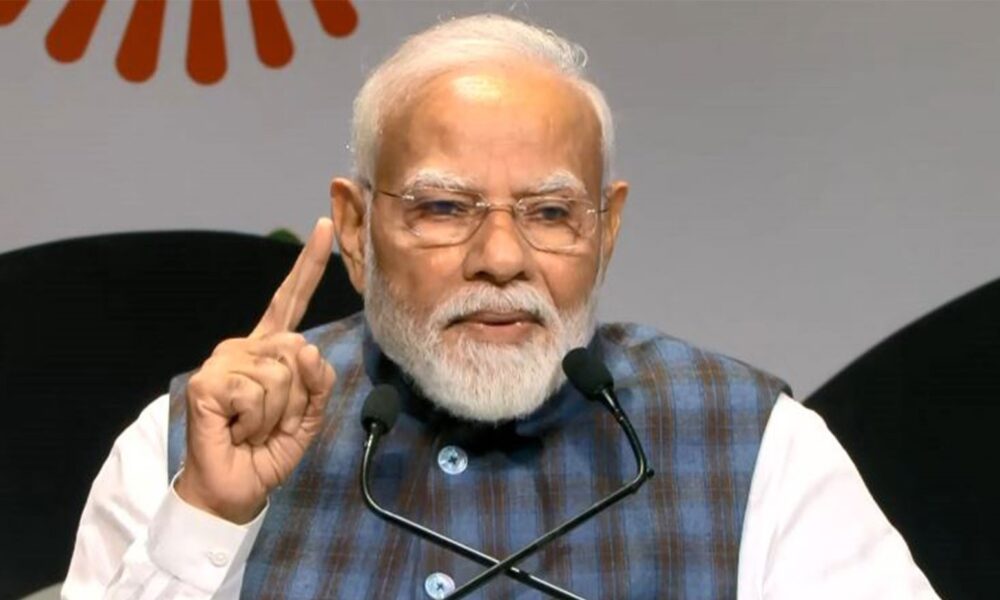
Prime Minister Narendra Modi on Thursday invoked Mahatma Gandhi’s 1930 message of self-reliance and indigenous goods, urging industry leaders to take the idea of Swadeshi to every household and strengthen the vision of an Atmanirbhar Bharat.
Addressing the annual general meeting and convention of the Federation of Indian Chambers of Commerce and Industry (FICCI) at Bharat Mandapam in New Delhi, PM Modi said the country needed to carry forward the message Gandhi had given nearly a century ago.
“Imagine, 100 years have passed, but in 1930, Gandhi left us with this message, and today, so many years later, I too have to say the same thing. Is this your success or your failure? Don’t listen to me; at least you could have listened to Gandhi! He too spoke of Swadeshi (indigenous goods) before leaving; he too spoke of Atmanirbhar Bharat (Self-Reliant India). And now you have turned 100 years old, yet things remain right where they were…Spread my message too to every home!” he said.
Taking a swipe at previous governments, the Prime Minister said the industry’s bitter past experiences continued to influence its relationship with the present government.
“Your experience with previous governments has been so bitter that I am having to bear the consequences. This is not the old government; this is a government of friends. It knows how to honour friendship, and you are my true friends. So, without hesitation or reservation, please write to me openly about what still needs to be improved,” he said.
PM Modi urged the pharmaceutical industry to reduce India’s dependence on imported active pharmaceutical ingredients (APIs), bulk drugs and drug intermediates, pointing out that the country, despite being known as the “pharmacy of the world”, continued to import billions of dollars’ worth of these products.
“India is called the ‘pharmacy of the world,’ yet it imports billions of dollars’ worth of APIs, bulk drugs, and drug intermediates every year. There are hundreds of categories in which we currently depend on imports. Our pharmaceutical industry must understand which ingredients we can manufacture in India. In which areas can we invest in new technology and large production plants to become competitive with other countries?” he said.
The Prime Minister also called on industry leaders to step up investment in agriculture and develop products tailored to demand in overseas markets.
“I would urge you to increase your industry’s investment in India’s agricultural sector. Set up reliable procurement systems with specific overseas markets in mind, and develop products for which there is demand there, so that Indian products can become our calling card around the world,” he said.
Highlighting India’s economic performance, PM Modi described the country as the world’s fastest-growing major economy, with projected growth of around 7 per cent. He said goods exports in October touched nearly USD 50 billion, marking the highest monthly figure on record.
“Today, India stands as the world’s fastest-growing major economy, with projected growth of around 7%. In October, India’s goods exports reached nearly $50 billion, our highest-ever monthly goods export. It is due to India’s strong performance that agencies like Moody’s Ratings, S&P Global Ratings, Fitch Ratings, the World Bank, and the Asian Development Bank (ADB) are revising our growth forecasts upward,” he said.
Referring to the government’s tax reforms, PM Modi said economic progress depended on respecting farmers, small entrepreneurs, industry, wealth creators and taxpayers.
“Any country progresses only by respecting its farmers, small entrepreneurs, industry, wealth creators, and taxpayers, not by abusing them morning and evening,” he said.
Recounting an interaction with the Income Tax Department after becoming Gujarat Chief Minister in 2001-02, PM Modi said he had questioned the practice of treating taxpayers with suspicion.
“Back around 2001–02, when I had newly become Gujarat CM, I addressed an Income Tax Department gathering and asked them: ‘When will you stop treating everyone like a thief? You also work for the country; everyone deserves respect’,” he said.
The Prime Minister cited the reduction in the basic corporate tax rate from 30 per cent in 2014 to 22 per cent and said individuals earning up to Rs 12 lakh were now exempt from income tax. He also highlighted the simplification of tax returns and refunds.
“We brought the basic corporate tax rate down from 30% in 2014 to 22%, and today there is no income tax on earnings up to ₹12 lakh. Did you increase your employees’ salaries or hire more staff? We also simplified returns and refunds; unlike earlier, when it took eight months, refunds now arrive within a week,” he said.
PM Modi said the government was ready to work alongside industry as the country moved forward on the “Reform Express”.
He also urged businesses not to take Indian consumers for granted and called for an end to the perception that export-oriented products were inherently of better quality.
“Do not take 140 crore Indians for granted as an assured market where anything will sell. Even today, sellers tell customers ‘this is export quality’ to convince them it is good. What do you take our countrymen for? Do they not deserve good quality? This mindset must change; my countrymen deserve top quality,” he said.
Referring to the free trade agreements (FTAs) signed by India with several major economies, the Prime Minister asked industry leaders to make use of the opportunities they offered.
“India has signed Free Trade Agreements (FTAs) with several major economies; doors have opened for you. Have you planned to seize this opportunity? If you do not take advantage of all my hard work, who will?” he said.
The FICCI convention, themed “Bharat 2047”, brought together more than 2,500 delegates, including industry leaders, chief executives, ambassadors, diplomats and policymakers. Discussions focused on India’s economic growth, global competitiveness, the next phase of reforms, manufacturing and the potential of artificial intelligence.
Founded in 1927, FICCI will complete 100 years on April 7, 2027. The industry body represents more than 2.5 lakh companies, directly and through over 300 affiliated regional and state-level industry associations. It also has partnership agreements with 250 national business associations across more than 100 countries, according to the Prime Minister’s Office.
(ANI Inputs)


No Comment! Be the first one.