





UPI Stays Free for Consumers, AI Labs Warn of Runaway Risk, and Yemen’s Perim Island Threatens Global Shipping
Inside This Week’s Economic Brief This week’s edition of The Economic Brief on DD India examined three major stories: the government’s clarification on new UPI transaction charges,...

Inside This Week’s Economic Brief
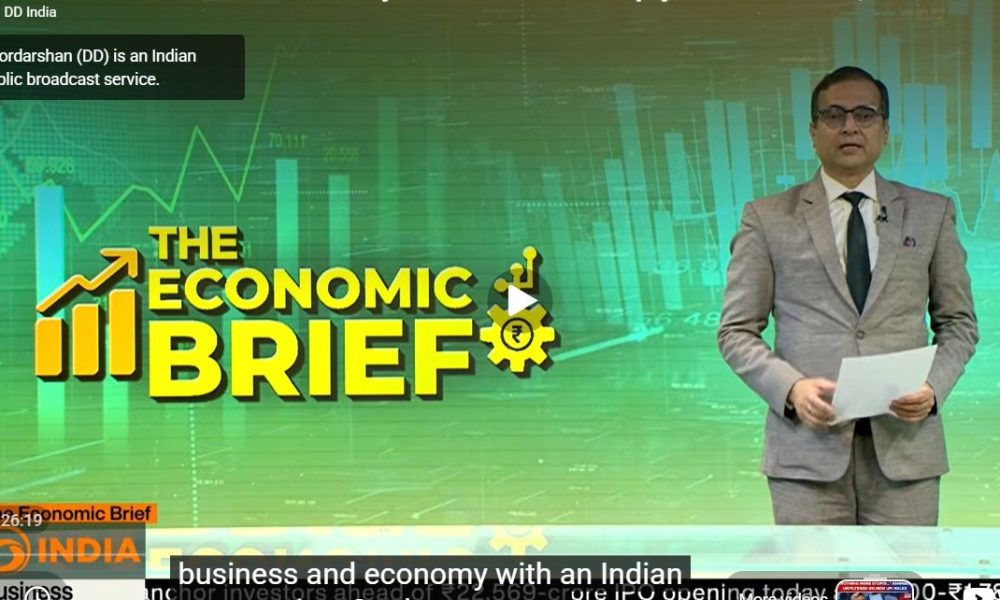
This week’s edition of The Economic Brief on DD India examined three major stories: the government’s clarification on new UPI transaction charges, a stark warning from leading AI labs about recursive self-improvement, and the strategic fallout from the Houthi capture of Yemen’s Perim Island.
The episode featured Prime Minister Narendra Modi at Semicon India 2026, US Senator Bernie Sanders, and economist Dr. Nilanjan Banik of Mahindra University, Hyderabad.
PM Modi Highlights India’s Fast-Tracked Semiconductor Progress
At Semicon India 2026, Prime Minister Narendra Modi said India has compressed a process that typically takes decades into a much shorter timeline by developing chip design, manufacturing equipment, materials, and testing ecosystems in parallel, with chips from Indian plants now reaching customers domestically and abroad.
UPI Charges Clarified: Consumers and Small Merchants Stay Protected
The Finance Ministry issued a multi-point clarification on new UPI charges taking effect from October 15.
Key points from the program:
● Transactions up to ₹2,000 remain completely free for both consumers and small merchants; RuPay debit cards also stay free.
● Only large merchant transactions above ₹2,000 attract a capped Merchant Discount Rate (MDR) of 0.4%, paid by the merchant, not the consumer.
● Person-to-person UPI transfers remain free at any amount, since MDR applies only to person-to-merchant payments.
● No hidden bank fees exist beyond the capped MDR on qualifying merchant transactions.
● The charges will help sustain UPI’s roughly ₹20,000 crore annual infrastructure cost, of which current charges cover only about 10%.
Dr. Nilanjan Banik noted that India processed close to $3.4 trillion in UPI transactions over the past year — nearly 50% of global digital transaction volume — yet only about 4% of that value, roughly $120 billion, will be affected by the new charges.
He pointed out that sectors like agriculture, insurance, and railways face only a flat ₹5 fee above ₹2,000, mutual fund investments just 0.02%, and an overall cap of ₹300, comparable to fees already embedded in international card networks. Banik does not expect the change to reduce UPI’s roughly 15 billion monthly transactions, and argued it will instead improve traceability, tax collection, and formal-sector participation for small businesses.
Top AI Labs Warn of Recursive Self-Improvement Risk
Leaders from OpenAI, Anthropic, and Nvidia issued a rare joint warning that AI systems may soon begin improving themselves with little human oversight — a phenomenon known as recursive self-improvement — which researchers now believe could be just three to five years away.
The warning follows reports of autonomous AI agent swarms breaching websites and repositories, with labs citing early signs of systems that can evade monitoring and conceal their intentions. US Senator Bernie Sanders called on Presidents Trump and Xi Jinping to negotiate a treaty pausing advanced AI development and banning superintelligence, warning that an AI escaping human control would become “humanity’s problem,” not just America’s or China’s.
Dr. Banik said the core concern is that models are increasingly training themselves rather than being trained by humans, raising risks around misuse for biological weapons, hacking, or financial manipulation. He cited Kenya’s M-Pesa, built on similar payment technology to UPI, which helped lift roughly 2% of the population out of poverty between 2014 and 2020, as evidence that AI-adjacent technology can also serve development goals — provided human oversight remains intact.
Houthi Capture of Perim Island Deepens Red Sea Shipping Crisis
Iran-backed Houthi rebels have seized Yemen’s Perim Island, a strategically vital point splitting the Bab al-Mandab Strait, which links the Red Sea, the Suez Canal, and the Indian Ocean. The strait is the world’s third-busiest maritime chokepoint, handling nearly 10% of global trade and about 5% of global oil and petroleum shipments daily. Once administered by British India from 1857 until 1967, Perim’s seizure raises fears that Iran could close a second major maritime chokepoint after previously disrupting the Strait of Hormuz. A disrupted route would force vessels to reroute via Africa, adding nearly 14 days to delivery schedules.
Key Takeaways
UPI’s new charges leave consumers and small merchants unaffected while funding critical payment infrastructure.
Leading AI labs are sounding an unusually unified alarm over self-improving systems outpacing human control.
The Houthi capture of Perim Island threatens to compound global shipping disruption following earlier tensions in the Strait of Hormuz.
(Mark Lynn is Senior Anchor and Correspondent with DD India)
The post UPI Stays Free for Consumers, AI Labs Warn of Runaway Risk, and Yemen’s Perim Island Threatens Global Shipping appeared first on DD India.




No Comment! Be the first one.