





Foreign Money Returns to India, Binance Survives a Record Hack, and Democrats Retake Congress
Inside This Week’s Economic Brief (This week’s Economic Brief covers the return of foreign investors to Indian equities, Binance’s resilience after a record $6.3 billion crypto hack, and the economic...

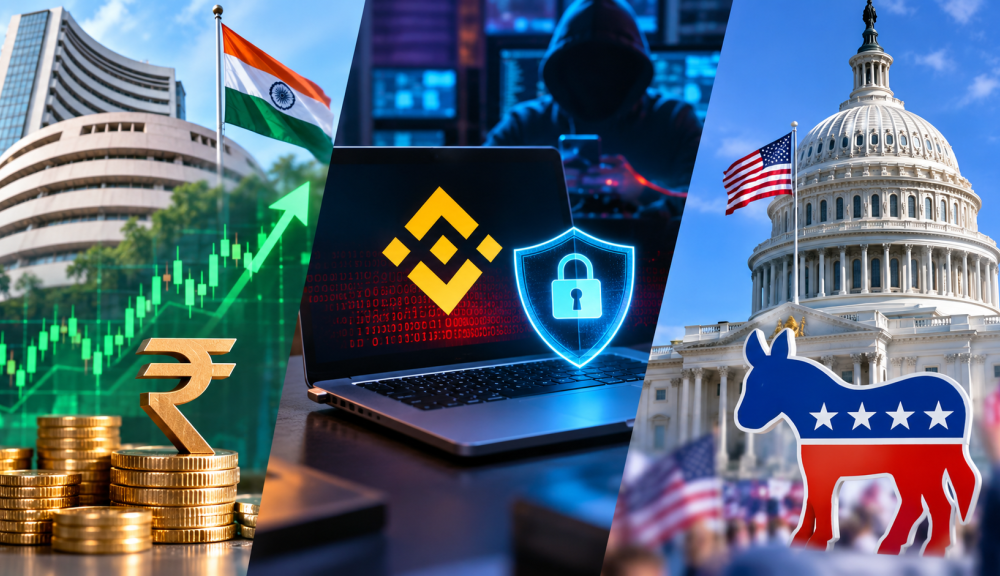
Table Of Content
Inside This Week’s Economic Brief
(This week’s Economic Brief covers the return of foreign investors to Indian equities, Binance’s resilience after a record $6.3 billion crypto hack, and the economic discontent that handed Democrats both houses of the US Congress.)
This week’s edition of The Economic Brief on DD India examined three major stories: a renewed wave of foreign portfolio investment into India, Binance’s recovery from the largest cryptocurrency theft ever recorded, and the 2026 US midterm elections, in which voters punished President Donald Trump and the Republican Party over prices, tariffs and the Iran war. The episode featured economist and author Prasenjit Basu.
Foreign Investors Return to India
Foreign portfolio investors put about $2.28 billion into Indian equities in the ten days up to around November 3, drawn by India’s position as one of the few large economies still delivering robust growth alongside solid corporate earnings. Several Indian majors across refining, infrastructure, steel, energy and telecom have reported year-on-year net profit growth of between 41% and 225%.
The programme identified several drivers behind the inflows:
- Global rotation. With US artificial intelligence and technology stocks under pressure, investors are diversifying, and India is increasingly seen as a “safe anti-AI option.” The Sensex and Nifty have consistently outperformed Asian peers, and Goldman Sachs has described India as one of the best-performing markets globally.
- The Jio listing. Jio’s listing attracted about $1.1 billion, roughly half of all foreign investment over the ten-day period, signalling confidence in one of India’s biggest growth stories. The company reported net profit up 14% year on year to ₹8,389 crore, with revenue up about 11%.
- A stable rupee. The rupee has held at around 94–95 to the dollar since June, boosting investor confidence.
- US political and market shifts. The midterm outcome and lower-than-expected US yields have encouraged money to move out of the United States.
Prasenjit Basu argued the inflows reflect more than rotation, pointing to improving fundamentals: corporate tax collections have grown about 16% year on year over the past six months, and the economy grew 7.8% in the latest quarter. He added that falling oil prices, partly reflecting reduced fears of arbitrary policy and new constraints on war-making now that President Trump has lost control of Congress, always benefit Indian markets. Rotation is also visible within India, with auto stocks performing strongly as domestic car sales rise at a spectacular pace, in contrast to China, where sales are down 23% year to date, while upstream oil stocks lag.
On currency stability, Basu said the Reserve Bank of India has shown over the past three to four months that it will not let the rupee fall beyond the 94–96 range, backed by ample foreign exchange reserves and October’s interest rate increase. After a nine-to-eleven-month period of rapid depreciation that drove heavy outflows, valuations have improved, and steady domestic mutual fund inflows through SIPs provide a cushion for foreign investors. Asked whether a recovery in US Treasury yields could reverse the trend, he noted that the new Democratic Congress is likely to bring more fiscal prudence from January, but that negotiations with the White House over taxes and spending will be difficult given the size of the US deficit.
Binance Withstands a Record $6.3 Billion Hack
On October 29, hackers allegedly linked to North Korea’s TraderTraitor group stole around $6.3 billion in digital assets from Binance’s hot wallets, making it the largest crypto theft on record. North Korea denied any involvement. Nearly every major blockchain was affected, including Ethereum, Bitcoin, Solana and XRP.
Binance halted withdrawals and launched an emergency response, while the wider crypto industry moved quickly: stablecoin issuers including Tether and Circle froze large portions of the stolen funds, and roughly $3 billion in assets was locked down. The exchange pledged that customers would not bear the losses, drawing on its Secure Asset Fund for Users (SAFU) and its own corporate resources. Because Binance did not face a solvency crisis, confidence largely held. Withdrawals resumed within days, and a company representative said that after an expected spike in the first 24 hours, activity had largely normalised. Investigators are now tracking the stolen funds in real time across public blockchains, making it difficult for the hackers to convert them into usable money.
Basu said Binance had demonstrated its resilience, largely thanks to SAFU, which functions much like deposit insurance funded by a small charge on every transaction. He said SAFU covered about $1 billion, Binance’s principal owners contributed about $3 billion of their own money, and all customer funds were made whole within about 48 hours. However, he cautioned that it remains unclear whether the stolen assets can be fully traced or recovered, and that if the largest and supposedly safest exchange is not entirely secure, “appropriate nervousness” about the crypto world is justified. Smaller exchanges, he warned, may lack similar cushions. As for conventional banks, he considered a comparable theft much harder to carry out given layered security procedures, while stressing the episode’s central lesson: confidence is everything in the financial system.
https://www.youtube.com/watch?v=vTftw34RfJE
Economic Discontent Hands Democrats Both Houses of Congress
The 2026 US midterm elections delivered a major setback for President Trump and the Republican Party, with Democrats taking control of both chambers of Congress. A post-election survey of more than 90,000 voters found the economy was the top concern, with more than half of voters ranking the economy and jobs among their top three national issues.
In the run-up to the vote, a Pew Research Center survey found that 74% of American adults were very concerned about gasoline and energy prices and 73% about the cost of food and consumer goods, followed by health care costs (69%), housing costs (66%) and unemployment (48%). The Iran war added to the pressure: disruptions around the Strait of Hormuz pushed US gasoline prices from about $2.98 per gallon before the war began on February 28 to over $4 by October 26, while diesel climbed from $3.76 to $6.35 per gallon, raising costs for truckers, farmers and businesses. President Trump had relaxed Russia-related oil sanctions in a bid to ease fuel prices, and senior Republicans, including the President, have since acknowledged the war was a factor in the results.
Tariffs also appear to have backfired, with many Americans concerned that import duties are raising costs for businesses and consumers. The report concluded that the outcome was largely a verdict on the administration’s handling of the economy rather than a straightforward endorsement of the Democrats, though Democrats also benefited from greater voter confidence on the economy and health care.
https://www.youtube.com/watch?v=hMXlhQT-oM0
Key Takeaways
Strong earnings, steady growth, a stabilised rupee and global rotation away from US tech are drawing foreign capital back to India, with the Jio listing as a headline catalyst. Binance’s swift response to a record hack showed that reserves, industry coordination and customer trust can prevent a run, though the episode leaves broader questions about crypto security unresolved. And the US midterms confirmed that pocketbook concerns, from fuel prices to tariffs, remain decisive for voters, setting up a new balance of power in Washington.



No Comment! Be the first one.