




‘Mann Ki Baat’ Completes 12 Years; PM Modi Showcases India’s Grassroots Achievements
Prime Minister Narendra Modi on Sunday highlighted grassroots innovation, rural healthcare, environmental conservation, traditional agriculture and scientific research during the 139th episode of his...

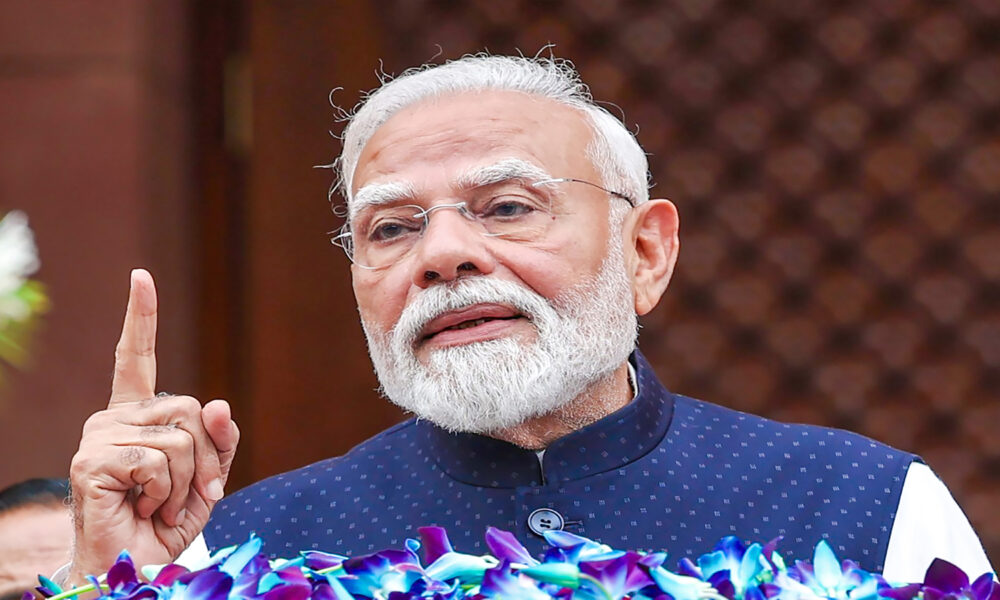
Prime Minister Narendra Modi on Sunday highlighted grassroots innovation, rural healthcare, environmental conservation, traditional agriculture and scientific research during the 139th episode of his monthly radio programme ‘Mann Ki Baat’. The programme, which began 12 years ago on Vijayadashami, has provided a platform to showcase the contributions of individuals and communities across the country.
Describing the programme as an opportunity to celebrate the efforts of ordinary citizens, the Prime Minister said it had brought numerous inspiring stories from different parts of India to the forefront.
He described ‘Mann Ki Baat’ as a journey to understand the efforts of people and acknowledge their contributions to society and the nation.
Traditional Skills and Organic Farming Empower Women
Highlighting the integration of traditional knowledge with innovative approaches, the Prime Minister spoke about the ‘Nav-Trinjan’ initiative in Punjab’s Malwa region, undertaken by the Kheti Virasat Mission to promote natural cotton cultivation and traditional weaving.
Under the initiative, organic cotton is cultivated without chemicals, including varieties with natural colours that reduce the need for chemical dyes.
The project has also established a weaving school to pass traditional skills on to the next generation and create livelihood opportunities for women.
Citing examples of women who have benefited from the initiative, the Prime Minister mentioned Ramandeep Kaur, who transitioned from labour work to skilled weaving, and Rekha Rani, whose handwoven shawl was presented to the President of India. He also highlighted the work of Suneha Devi and Rajni Kaur, who have developed weaving skills to support their households.
The Prime Minister extended his best wishes to the team, acknowledging its efforts to preserve traditional crafts while creating economic opportunities.
Community Efforts Help Revive Uttarakhand’s Heval River
Emphasising the importance of environmental conservation, the Prime Minister highlighted community-led efforts to revive the Heval river in Uttarakhand’s Tehri Garhwal region.
He said declining water levels in the river and the drying up of natural water sources had prompted the local administration and villagers to work together to address the problem.
Measures such as rainwater harvesting, groundwater recharge and large-scale tree plantation were undertaken as part of the campaign. According to the Prime Minister, these efforts have helped revive the river and restore several natural water sources.
He also called for collective participation in cleanliness drives during the upcoming Diwali and Chhath festivities, stressing that individual efforts can bring significant changes to local surroundings.
‘Vocal for Local’ Opens Global Markets for Indian Products
The Prime Minister said the growing preference for Swadeshi products during the festive season was helping Indian goods reach international markets.
Citing examples, he said makhana from Purnia in Bihar was reaching Greece, while arhar dal from Kalaburagi in Karnataka was being exported to the Maldives.
He also highlighted the importance of product packaging in improving market appeal and expanding commercial opportunities for local producers.
In Maharashtra, the ‘Shabari Naturals’ initiative is marketing products such as honey, mahua, chironji and bamboo-based items in packaging inspired by tribal art. The Prime Minister noted that the packaging had received Japan’s Good Design Award.
He also referred to a Karnataka-based bamboo start-up developing packaging materials from bamboo and agricultural residue.
Highlighting the growing popularity of Khadi, the Prime Minister said sales of Khadi Gram Udyog products exceeded ₹28 crore on Gandhi Jayanti this year, an increase of ₹1.5 crore compared with the previous year.
He urged citizens to prioritise products made by local artisans during festive shopping, saying that such purchases would support their livelihoods and strengthen the ‘Vocal for Local’ movement.
e-Sanjeevani Records Nearly 50 Crore Teleconsultations
Highlighting the role of technology in improving access to healthcare, the Prime Minister said the e-Sanjeevani telemedicine platform had facilitated approximately 50 crore teleconsultations.
He cited examples from the Andaman and Nicobar Islands, Lakshadweep, Ladakh and Nagaland to illustrate how remote consultations had helped patients access specialist medical advice.
In the Andaman and Nicobar Islands, a child from the Jarawa tribe on Baratang Island received specialist medical assistance after developing a high fever and breathing difficulties. The child was diagnosed with pneumonia, and his condition improved following treatment.
In Lakshadweep, a patient named Kunhi Koya received medical guidance through a consultation connecting local health workers with a doctor in Kavaratti. In Zanskar, Ladakh, e-Sanjeevani enabled specialist assistance for Kunjang Dolma during pregnancy complications. A 12-year-old boy in Nagaland also benefited from a remote consultation for an ear infection and fever.
The Prime Minister also highlighted the role of nearly 1.9 lakh Ayushman Arogya Mandirs in expanding access to healthcare and encouraging regular health check-ups in rural areas.
He said e-Sanjeevani demonstrated how technology, the commitment of doctors and public trust could work together to make healthcare more accessible.
IIT Madras Brain Centre Advances Research
During the programme, the Prime Minister highlighted the Sudha Gopalakrishnan Brain Centre at IIT Madras, which he inaugurated earlier this month during his visit to Chennai.
The centre has developed a brain-imaging technology platform to create high-resolution digital three-dimensional images of the human brain. Its initial mission is to map and study 100 human brains in detail using the Param Shakti supercomputer.
The Prime Minister said the initiative could contribute to a deeper understanding of the human brain and support future research into conditions such as Alzheimer’s disease and dementia.
He added that data from the 100 human brains would be made available as an open-source resource for research across different fields.
The Prime Minister also highlighted the importance of organ donation in supporting medical research, citing the family of Shivani from Narmadapuram in Madhya Pradesh, which decided to donate her organs following a fatal road accident.
He said the family’s decision reflected a spirit of humanity and could support both life-saving efforts and scientific research.
Start-ups Explore AI, Electric Aviation and Advanced Batteries
Recalling his interactions with young innovators and researchers in Chennai, the Prime Minister highlighted start-ups working on solutions to everyday challenges and emerging technological needs.
These included technologies to verify the purity of gold, platforms to help recover money lost to banking fraud, and the use of artificial intelligence in cervical cancer screening.
He also referred to deep-tech start-ups at IIT Madras working on an electric vehicle capable of flying over the sea, fast-charging batteries for drones and electric vehicles, and applications of AI in defence technology.
The Prime Minister said the availability of an appropriate ecosystem and institutional support was helping young innovators translate their ideas into new technologies.
He also paid tribute to Indian scientist Narinder Singh Kapany, widely known as the Father of Fibre Optics, ahead of his 100th birth anniversary on October 31. Born in Punjab’s Moga district, Kapany’s research into the transmission of light through thin fibres contributed to the development of modern communication technologies.
Millet Cultivation Gains Momentum in the Northeast
The Prime Minister highlighted efforts in Meghalaya and Nagaland to revive millet cultivation by combining traditional agricultural practices with value addition and modern farming methods.
In Khanduli village of Meghalaya’s West Jaintia Hills district, two women entrepreneurs developed millet-based products such as cookies, cakes, muffins and baby food. The initiative increased demand for these products and encouraged farmers to resume millet cultivation.
In Sadolpara village in West Garo Hills, farmer Chekjing Sangma adopted modern methods of millet cultivation, improving his income and raising awareness about the crop.
The Prime Minister also referred to Kezoma village in Nagaland’s Kohima district, where millet cultivation resumed in 2024 after being discontinued for more than a decade. The village organised its first millet festival in 2025.
He said these examples demonstrated how traditional crops could create new economic opportunities while preserving local food cultures.
PM Modi Recalls Contributions of Maharishi Valmiki and Bhai Parmanand
The Prime Minister also spoke about India’s cultural and freedom movement heritage, recalling the contributions of Maharishi Valmiki and freedom fighter Bhai Parmanand.
Ahead of Maharishi Valmiki’s birth anniversary on October 26, he highlighted the values of compassion, service, persistent effort and social harmony reflected in the Valmiki Ramayan. He referred to the examples of Bhagwan Ram’s interactions with Mata Shabari and Nishadraj as illustrations of respect and inclusiveness.
The Prime Minister also recalled the 150th birth anniversary of Bhai Parmanand, to be observed on November 4. Associated with the Arya Samaj and the Ghadar Party, Bhai Parmanand played a role in India’s freedom movement and was sentenced to imprisonment in the Andaman Islands by the British authorities.
The Prime Minister urged young people to learn about his life and sacrifices, including his contributions to education after his release from prison.
He also called on citizens to participate in the ‘Run for Unity’ on October 31, marking the birth anniversary of Sardar Vallabhbhai Patel and reaffirming the message of national unity.
Concluding the programme, the Prime Minister extended his greetings for Diwali, Chhath and other upcoming festivals, urging people to celebrate safely and share their happiness with others.
-PIB
The post ‘Mann Ki Baat’ Completes 12 Years; PM Modi Showcases India’s Grassroots Achievements appeared first on DD India.



No Comment! Be the first one.